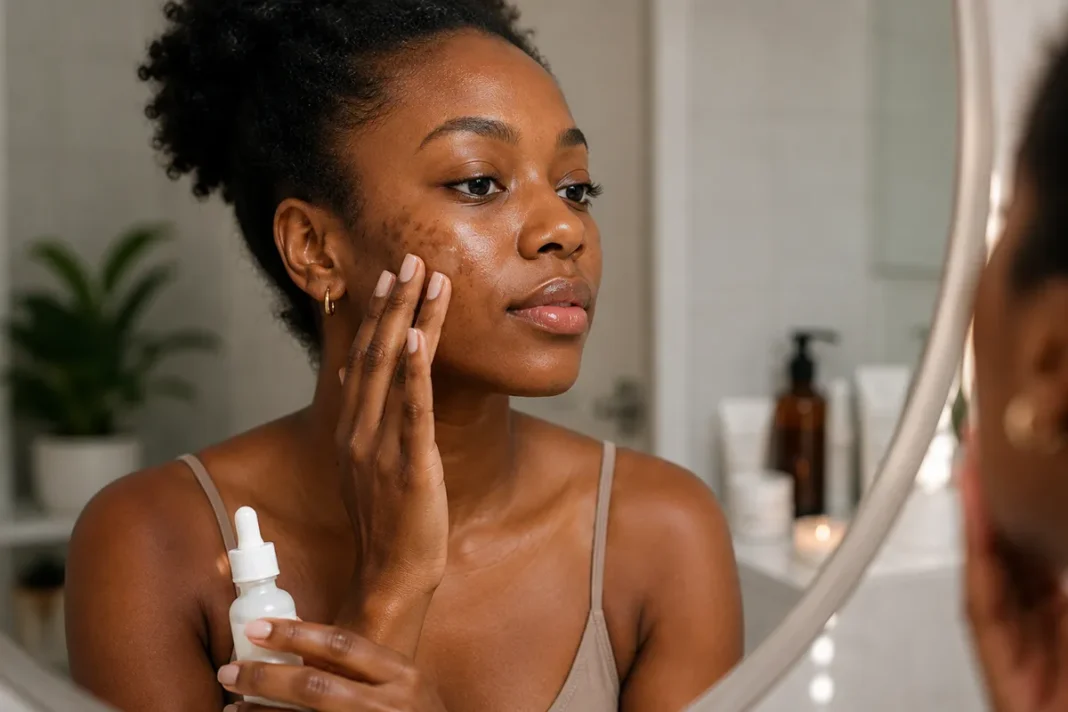

Treating hyperpigmentation on dark skin means working with your skin’s biology, not against it. Start with a tinted, iron-oxide sunscreen daily—it blocks both UV and visible light that deepens spots. Layer proven actives like niacinamide, tranexamic acid, and azelaic acid, and control any active acne or eczema driving new pigment. Avoid aggressive peels or over-exfoliation, which can worsen discoloration on melanin-rich skin. Keep exploring—there’s a lot more to unpack.
Key Takeaways
- Dark skin hyperpigments more easily due to higher eumelanin content and reactive melanocytes, making gentle, non-irritating treatment approaches essential.
- Identify pigment depth first — epidermal pigment responds to topical treatments, while dermal pigment resists surface actives and requires longer timelines.
- Control underlying inflammation, especially acne, before treating dark spots, as unresolved flares continuously trigger fresh pigment deposits.
- Avoid picking, over-exfoliating, or layering too many actives, since low-grade irritation stimulates melanocyte activity and worsens hyperpigmentation.
- Use tinted SPF 46–50 sunscreen daily with iron oxides to block visible light, which accelerates pigmentation beyond standard UV protection.
Why Dark Skin Is More Prone to Hyperpigmentation
Your skin also contains more eumelanin, larger melanosomes, and more acidic melanocyte dendrites — all of which accelerate pigment transfer into surrounding keratinocytes.
Add a structural tendency toward low-grade chronic inflammation, elevated cytokines, and a more reactive epidermal architecture, and you have a system primed to hyperpigment after even minor insults.
This isn’t a flaw. It’s biology. But understanding it’s the first step toward treating dark skin effectively — without triggering the very problem you’re trying to correct. Hyperpigmentation is among the top five most commonly diagnosed skin conditions in Black people, which reflects just how readily this biological system responds to everyday triggers.
Epidermal vs. Dermal Hyperpigmentation: Why the Difference Determines Your Treatment
Before you choose a single product or book a treatment, you need to know where your pigment actually lives — because epidermal and dermal hyperpigmentation don’t just look different, they behave differently, clear differently, and can worsen under the exact same approaches that help the other.
Epidermal pigment sits within the outer skin layers. It appears tan to dark brown with sharp edges, responds to tyrosinase inhibitors, and exits through natural cell turnover.
Dermal pigment has crossed the basement membrane and become trapped in macrophages deep within the skin. It reads as gray, ashy, or blue-brown with soft, shadowy edges — and it largely ignores surface-level treatments.
Misidentifying your pigment type doesn’t just stall progress. On dark skin, it can actively deepen the problem. Many cases present as mixed hyperpigmentation, with pigment existing in both layers simultaneously, which is why features of each type may appear together rather than in isolation.
Why Clearing Acne and Eczema Is Part of Treating Hyperpigmentation
When acne flares or eczema lingers, the inflammation itself — not just the visible lesion — is actively triggering melanocyte activity and driving new pigment deposits into your skin. Treating the dark spots while leaving the underlying condition uncontrolled is like mopping the floor while the faucet’s still running.
For darker skin tones, this matters even more. Your melanocytes are more reactive, meaning every unresolved flare compounds existing pigmentation and creates fresh damage. Clearing acne and eczema isn’t a separate step — it’s foundational to your hyperpigmentation treatment.
Retinoids, azelaic acid, and niacinamide work precisely because they address both problems simultaneously: calming inflammation while slowing melanin overproduction. Control the source, and you stop feeding the cycle that’s keeping your skin uneven. Acne alone accounts for up to 65% of postinflammatory hyperpigmentation cases, making it the single most important underlying condition to resolve.
Daily Habits That Silently Deepen Dark Spots on Dark Skin
Even when you’re consistent with serums and sunscreen, certain everyday habits can quietly undo that progress — and on darker skin tones, the damage compounds faster than you’d expect.
Picking at breakouts, scratching insect bites, or rubbing skin with rough towels repeatedly triggers post-inflammatory hyperpigmentation that’s more intense and persistent in melanin-rich skin.
Tight clothing, headscarves, and masks create chronic friction that gradually darkens contact areas.
Over-exfoliating or layering too many active ingredients at once causes low-grade irritation that drives melanocyte activity rather than calming it.
Unprotected sun exposure remains the strongest accelerant — but blue light from screens compounds the problem too.
Even diet matters: high-sugar, processed foods increase systemic inflammation that worsens uneven tone.
These habits don’t announce themselves — they accumulate silently. Hormonal shifts during puberty or pregnancy can also trigger melanin overproduction, meaning lifestyle habits alone don’t always explain why dark spots suddenly worsen or spread.
The Right Sunscreen Makes or Breaks Your Results
Those silent habits wear down your progress from the inside — but what happens on the outside, specifically what you put on last every morning, can either lock in your results or quietly erase them. Sunscreen isn’t optional for dark skin managing hyperpigmentation. It’s the foundation everything else depends on.
You need broad-spectrum SPF 30 minimum — SPF 46–50 is better. But here’s what most people miss: UV isn’t your only threat. Visible light triggers deeper, more persistent pigmentation in darker skin tones than UVA alone. That’s why your sunscreen must contain iron oxides.
Tinted, iron-oxide formulations filter at least 60% of high-energy visible light, prevent melasma relapse, and eliminate the white cast that makes mineral sunscreens unwearable on dark skin. That combination is non-negotiable. In one clinical trial, participants using a sunscreen that combined UV and visible light protection alongside hydroquinone achieved a 75% MASI score reduction — compared to just 60% with a UV-only sunscreen.
The Topical Ingredients That Actually Fade Dark Spots on Dark Skin
Sunscreen holds your results — but topical actives are what create them. For dark skin, the right ingredients matter because the wrong ones cause more damage than the spots themselves.
Hydroquinone 4% remains the gold standard, but it’s not your only option. Azelaic acid, kojic acid, cysteamine, and tranexamic acid all deliver real results — especially when hydroquinone isn’t suitable long-term. Niacinamide reduces melanin transfer, vitamin C brightens gradually, and plant-derived ingredients like licorice and arbutin inhibit tyrosinase without aggressive irritation.
One rule applies across every ingredient: epidermal hyperpigmentation responds. Dermal pigmentation largely doesn’t — so identifying your lesion type before committing to a regimen saves you time, money, and unnecessary inflammation. Choose strategically, not impulsively. With prolonged hydroquinone use, switching to a non-hydroquinone alternative is advised to prevent exogenous ochronosis from developing.
How Retinoids Speed Up Fading and Boost Other Ingredients
Retinoids don’t just fade dark spots — they accelerate the entire process by which your skin removes them. By speeding up cell turnover, they push pigment-loaded keratinocytes to the surface faster, shedding excess melanin before it deepens. Simultaneously, they suppress tyrosinase activity and block melanosome transfer from melanocytes into surrounding skin cells, cutting off pigment production at its source.
That dual action — removing existing pigment while limiting new formation — makes retinoids uniquely efficient for dark skin. They also restructure the stratum corneum, making it more permeable to whatever else you’re applying. Vitamin C, niacinamide, or azelaic acid penetrate deeper and perform better alongside a retinoid.
You get more results from fewer ingredients, with less risk of the irritation that triggers new hyperpigmentation. When combining ingredients, using vitamin C in the morning and retinol at night allows each to work through its separate melanin-inhibiting pathway without interference.
Combination Therapy vs. Single Ingredients: What Works Better for Dark Skin?
When it comes to fading hyperpigmentation on dark skin, combination therapy consistently outperforms single ingredients — and the clinical data makes that gap hard to ignore.
A triple combination cream containing hydroquinone, tretinoin, and a mild corticosteroid produced over 75% improvement in 73% of users versus 49% using hydroquinone alone. You’re also looking at faster results — visible clearing by week four rather than months of waiting.
For post-inflammatory hyperpigmentation, the pattern holds: fixed-dose combinations deliver faster, more pronounced lightening than any single-ingredient approach.
That said, combination therapy isn’t indefinite. Improvement typically plateaus around six weeks, so shifting to a maintenance regimen protects your progress without prolonged exposure.
The takeaway is straightforward — strategic combinations give your skin a more powerful, efficient path to clarity. In a study of 120 patients, no discontinuations occurred due to drug-related adverse events, suggesting combination therapy can be well tolerated throughout the treatment period.
When Hydroquinone and Retinoids Aren’t Enough: Newer Ingredients to Try
Sometimes hydroquinone and retinoids simply don’t cut it — and for darker skin tones, continuing to push ineffective treatments isn’t just frustrating, it’s risky. Fortunately, newer ingredients offer real alternatives.
Tranexamic acid works through multiple routes — oral, topical, or intradermal — reducing UV-triggered melanogenesis and inflammatory pigmentation. Studies show up to 90% improvement in melasma cases, with fewer irritant reactions than hydroquinone, making it especially safer for your skin type.
Cysteamine cream modulates tyrosinase without harsh side effects, working best for mild-to-moderate or maintenance cases. Niacinamide strengthens your barrier while visibly lightening persistent discoloration — a practical addition when irritation is a concern.
These aren’t backup options. They’re legitimate, evidence-supported tools that respect how your skin actually responds. Oral tranexamic acid in particular has shown clear efficacy for melasma at low doses over short treatment periods of just 8 to 12 weeks, making it a practical consideration when topical therapies have failed.
Are Chemical Peels and Lasers Safe for Dark Skin?
Building on topical treatments, some cases call for procedural options — and that’s where chemical peels and lasers often enter the conversation. If you have darker skin, these treatments aren’t off-limits, but they demand careful selection and an experienced provider.
Superficial peels using glycolic, lactic, mandelic, or salicylic acid are your safest starting points. Medium and deep peels markedly raise your risk of post-inflammatory hyperpigmentation, scarring, and dyspigmentation — the exact problems you’re trying to solve.
With lasers, longer-wavelength devices like the 1064-nm Nd:YAG work more safely on melanin-rich skin. Non-ablative and low-energy fractional options also carry lower pigmentary risk. Cooling, longer pulse durations, and test spots help protect your skin further. The right provider makes all the difference.
Salicylic acid peels are particularly well-suited to darker skin because their anti-inflammatory action helps reduce the risk of post-inflammatory hyperpigmentation that other peeling agents can trigger.
How Long Does Hyperpigmentation Take to Fade on Dark Skin?
One of the most frustrating realities of hyperpigmentation on dark skin is that it rarely disappears quickly. Your melanocytes are highly reactive, meaning pigment forms faster, sits deeper, and lingers longer than it would on lighter skin tones.
Epidermal pigmentation typically fades within 6–12 months with consistent sun protection and treatment. Dermal pigmentation is more stubborn—it can persist for 1–5 years, and some cases become permanent. Without any treatment, studies report an average recovery time of roughly 21 months, with many cases showing only partial improvement.
Your timeline depends on pigment depth, sun exposure, and how consistently you treat the underlying cause. Managing your expectations honestly isn’t defeat—it’s strategy. Long-term, committed care produces the clearest results. In fact, research shows that acne-driven inflammation is responsible for the vast majority of post-inflammatory hyperpigmentation cases, making consistent acne management one of the most important steps in preventing new pigmentation from forming.
Maintenance Ingredients and Habits That Prevent Hyperpigmentation From Returning
Clearing hyperpigmentation is only half the work—keeping it gone requires an equally deliberate approach.
Your daily sunscreen, ideally tinted with iron oxides, blocks both UV and visible light, two known pigment triggers on darker skin. Reapply every two hours, and pair it with a vitamin C serum for reinforced protection.
For maintenance, lean on niacinamide, azelaic acid, alpha arbutin, and tranexamic acid—ingredients that keep melanocyte activity controlled without harsh side effects. Gentle exfoliating acids like mandelic and lactic acid clear pigmented surface cells without provoking new inflammation. Retinoids sustain steady cell turnover while ceramide-rich moisturizers protect your barrier.
Consistency is non-negotiable.
A morning routine of cleanser, antioxidant serum, pigment-targeting serum, moisturizer, and sunscreen preserves your results and keeps new dark marks from forming. Even after existing spots clear, new spots can form, so maintaining protective habits long-term is essential to preventing recurrence.
References
- https://www.goodrx.com/conditions/skin-discoloration/hyperpigmentation-darker-skin-tones-treatments
- https://www.healthline.com/health/skin/hyperpigmentation-on-black-skin
- https://pubmed.ncbi.nlm.nih.gov/20725554/
- https://assets.cureus.com/uploads/review_article/pdf/474291/20260517-191380-uubd98.pdf
- https://pubmed.ncbi.nlm.nih.gov/39075672/
- https://cityskinclinic.com/treatments-hyperpigmentation-dark-skin/
- https://www.ncbi.nlm.nih.gov/books/NBK559150/
- https://my.clevelandclinic.org/health/diseases/21885-hyperpigmentation
- https://www.aad.org/public/everyday-care/skin-care-secrets/routine/fade-dark-spots
- https://pmc.ncbi.nlm.nih.gov/articles/PMC9165630/