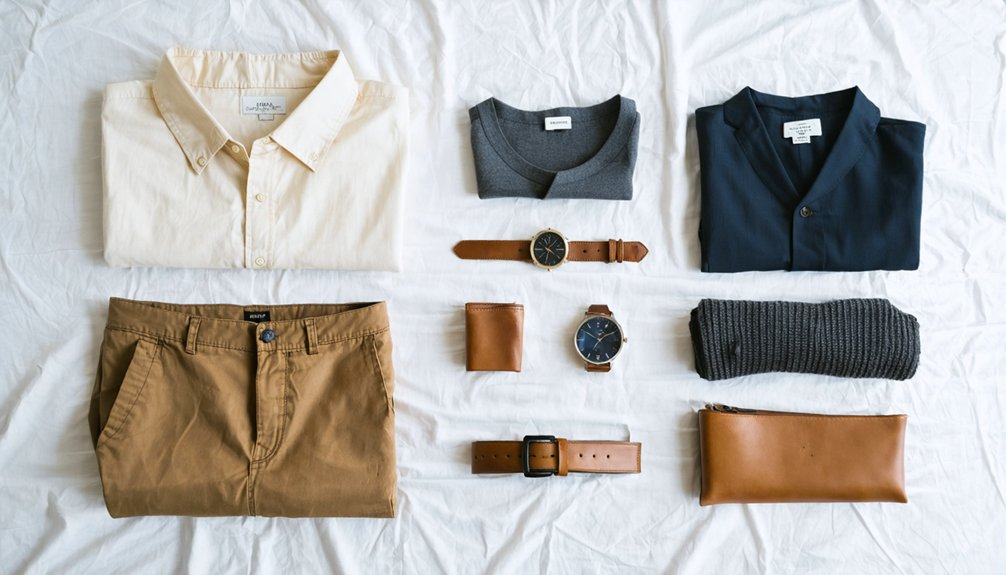

To build a capsule wardrobe that reflects your personal style, start by auditing what you already own and identifying the pieces you consistently reach for. Define your aesthetic using three precise adjectives, then build a cohesive color palette of five to eight tones anchored by neutrals. Keep only what fits well, suits your lifestyle, and supports your chosen look. Aim for 25–50 versatile pieces that coordinate effortlessly. Everything ahead will show you exactly how.
Key Takeaways
- Audit your most-reached-for pieces, document outfits for 30 days, and condense your style into three precise adjectives as an editorial filter.
- Build a deliberate color palette of two to four neutrals, three main colors, and one to four accents for effortless coordination.
- Choose timeless core pieces — neutral tees, tailored trousers, versatile knits, and two outerwear options — that combine across multiple occasions.
- Aim for 25–50 garments, adjusting for your dress codes, climate, and laundry rhythm to match your actual lifestyle.
- Shop intentionally with a specific list, defined silhouettes, and quality criteria, applying the one-in, one-out rule to maintain cohesion.
What a Capsule Wardrobe Is and Why It Actually Works
A capsule wardrobe is a small, curated collection of versatile clothing items that combine to create multiple outfits across many occasions. Built around timeless staples—classic trousers, enduring outerwear, foundational tops—it operates through a cohesive color palette that makes every piece coordinate effortlessly.
The concept dates to the 1940s but gained modern clarity through retailer Susie Faux in the 1970s, who framed it as high-quality essentials forming a wardrobe’s backbone. Donna Karan popularised the concept further in 1985 with her collection of seven interchangeable work-wear pieces.
Here’s why it works for you: fewer choices eliminate decision fatigue, pre-coordinated pieces accelerate your morning routine, and clear criteria filter out impulse purchases. You’re not restricting yourself—you’re liberating yourself from closet chaos. A streamlined wardrobe demands less of your mental energy and returns more of your time, confidence, and intentionality.
How Many Pieces Does Your Capsule Wardrobe Actually Need?
The number that comes up most often lands somewhere between 25 and 50 garments—with many experts zeroing in on the low 30s as the most practical sweet spot. Popular minimalist frameworks cite 33 or 37 pieces as reliable targets, though your ideal count depends entirely on your life.
Consider your distinct dress codes—office, casual, active, festive—alongside your climate and laundry rhythm. Remote workers in temperate regions often function beautifully with 18–22 pieces. Multi-season, multi-role lifestyles typically call for 35–45. If you’re washing clothes less frequently, add roughly five items to compensate.
There’s no single correct number. What matters is that every piece earns its place. When your wardrobe serves your actual life, you stop managing clothes—and start wearing them with intention. Your total count may also shift based on whether you choose to include accessories, shoes, or workout apparel in your inclusion criteria.
Audit What You Already Own
Before you can build something intentional, you need to see exactly what you’re working with. Pull everything out — closets, drawers, storage boxes, off-season pieces — and lay it all on a flat surface. No exceptions.
From there, categorize each item by type, season, and occasion. Note fabric, condition, fit, and how often you actually wear it. A simple spreadsheet or closet app works well for tracking this data systematically.
Then calculate cost per wear: original price plus maintenance costs, divided by total estimated wears. This single metric reveals where your money has served you and where it hasn’t.
What you wear most tells the truth about your style. What you avoid tells an equally important story. Both are essential before moving forward. Don’t overlook secondary storage locations like coat closets, linen closets, and dressers, as they often hold forgotten pieces that belong in your full inventory count.
Edit Your Capsule Wardrobe: What Stays and What Goes
Once the audit is done, it’s time to cut through the noise and make deliberate decisions about what earns a place in your capsule.
Keep pieces you’ve reached for consistently within the last six to twelve months, that fit well without adjustment, and that genuinely support your chosen aesthetic.
Remove anything that hasn’t been worn, pulls uncomfortably, shows fabric fatigue, or exists purely for fantasy occasions you never actually have.
These pieces are quietly draining your wardrobe’s power.
For “maybe” items, don’t guess—test.
Run a focused ten to thirty-day capsule trial using only your strongest contenders.
Track what you actually wear.
What gets skipped repeatedly earns its exit.
This process isn’t about scarcity; it’s about reclaiming a closet that works entirely for you. To keep your capsule relevant over time, schedule routine closet assessments approximately every three months to retire worn pieces and identify anything that’s gone missing.
Define Your Personal Style Before You Edit
Editing without a clear sense of your personal style is like packing for a trip without knowing the destination—you’ll end up with the wrong things.
Start by auditing what you already own and separating your most-reached-for pieces. They’ll reveal your true aesthetic faster than any quiz. Document your outfits for 30 days, noting silhouettes, colors, and formulas that repeat.
Then collect 20–30 inspiration images and reduce them to five that feel unmistakably *you*. Analyze what they share: tailoring sharpness, color intensity, accessory scale, overall mood.
Cross-reference that visual language with your lifestyle—work, climate, activity level—so your defined style stays wearable, not just aspirational. Use the Style Ikigai method to map the overlap between what you genuinely love to wear, your actual lifestyle needs, and your style aspiration.
Finally, condense everything into three precise adjectives. Those words become your editorial filter for every decision ahead.
Build a Color Palette for Your Capsule Wardrobe
Your capsule wardrobe’s color palette is its structural backbone—get it wrong and nothing mixes, get it right and every piece you own becomes a viable option.
Start with two to four neutrals: black, white, navy, or camel work reliably across almost every outfit combination. These form your blank canvas.
Next, choose three main colors for key pieces like coats, trousers, and jackets. These shades define your wardrobe’s visual identity and should repeat across multiple categories.
Finally, add one to four accent colors—reserved for accessories and single statement items—that complement every neutral and at least two main colors.
A simple formula keeps everything balanced: roughly 60% neutral, 30% main color, 10% accent. Follow it, and dressing becomes effortless rather than exhausting.
Your natural coloring—skin tone, hair, and eyes—should guide which neutrals and mains you anchor your palette around, since colors that echo your personal undertone and contrast level tend to brighten the face rather than compete with it.
Pick Fabrics and Fits That Work Together
Choosing the right fabrics and fits is what separates a capsule wardrobe that actually works from one that just looks good on paper. Prioritize breathable, durable base fabrics—cotton, linen, merino wool, and TENCEL™ form the foundation of pieces you’ll actually reach for. When low-maintenance matters, blend in performance synthetics for wrinkle resistance and shape retention without sacrificing comfort.
Fit is equally non-negotiable. Choose straight, slightly relaxed cuts in trousers, classic silhouettes in blazers, and tops with moderate ease so everything layers and shifts effortlessly. Dresses with clean lines and subtle waist shaping move from casual to polished without effort.
Wool stands out as a particularly smart investment because it is naturally wrinkle and odor resistant, meaning pieces stay fresh and presentable through multiple wears between washes.
When your fabrics and fits work in harmony, getting dressed stops feeling like a compromise—and starts feeling like a choice that’s entirely yours.
The Core Pieces Every Capsule Wardrobe Should Include
Once you’ve nailed the right fabrics and fits, the next step is knowing exactly which pieces to build around. Start with three to four neutral tees, two to three collared shirts, and one elevated blouse for smarter occasions.
For bottoms, you’ll want two to three pairs, including dark tailored trousers and well-fitted denim in a versatile wash. Layer those with one to two neutral knits, a cardigan, and a structured blazer that instantly sharpens any look.
Outerwear comes down to two strategic choices: one tailored coat and one lighter jacket. Complete the foundation with three pairs of shoes spanning casual, smart-casual, and formal. Together, these pieces give you maximum outfit combinations without the overwhelm of an overstuffed closet. To keep the whole wardrobe feeling intentional rather than flat, include one or two statement pieces that inject personality without disrupting the overall coordination.
How to Express Your Style Within a Capsule Wardrobe
A capsule wardrobe only works as hard as the style identity behind it. Before curating pieces, define your aesthetic using your most-worn garments as evidence. Notice recurring fits, fabrics, and details, then distill them into a concise style statement that guides every keep-or-remove decision.
From there, build a deliberate color palette of five to eight tones, anchored by three to five neutrals with accent shades that reflect your personality. Choose silhouettes intentionally, balancing fitted and relaxed elements to create proportion without sacrificing comfort.
Finally, let fabric and texture do the talking. Crisp cotton signals polish; linen suggests ease. When your palette, silhouette, and materials align under one clear concept, your capsule stops feeling like a limitation and starts functioning like a signature. A tight, disciplined palette of core neutrals like cream, camel, and black, accented with cognac or navy, ensures every piece you own connects to the next.
Use Accessories to Multiply Your Outfit Options
Accessories do the heavy lifting in a capsule wardrobe, stretching a core collection of garments far beyond what the clothing alone can achieve. A curated set of 8–15 pieces — bags, jewelry, belts, scarves, and hats — eliminates decision fatigue while unleashing genuine outfit variety.
Choose accessories in a cohesive neutral palette with a few accent tones to guarantee compatibility across your entire wardrobe. Let jewelry shift mood instantly: minimal gold hoops and delicate rings for everyday polish, one bold statement piece when you want impact. Use belts to reshape silhouettes, bags to signal occasion, and footwear to pivot between casual and dressed-up. Scarves and hats add texture, print, and personality without touching your core garments. Quality over quantity — every piece should earn its place.
A silk scarf in a rich jewel tone or playful print can be draped over the shoulders, wrapped around the neck, tied to a bag, or worn as a hair wrap, making it one of the most versatile capsule accessories with the smallest storage footprint.
Shop Intentionally to Complete Your Capsule Wardrobe
Before you spend a single dollar, you need a strategy. Audit your closet first — pull everything out, sort it honestly, and identify real gaps rather than perceived wants. That audit becomes your shopping list.
Keep that list specific. You’re not shopping for “something cute.” You’re shopping for a black blazer, neutral ankle boots, or a versatile coat — anchor pieces that carry multiple outfits.
Set quality and budget criteria before you browse. Define your color palette, preferred silhouettes, and maximum item counts per category. These boundaries aren’t restrictions; they’re your liberation from impulse buying and wardrobe chaos.
When you shop with intention, every purchase earns its place. Nothing enters your closet without purpose, and nothing leaves you feeling like you still have nothing to wear. A well-built capsule ensures every piece you own coordinates effortlessly with the others, so getting dressed becomes a confident, deliberate act rather than a daily struggle.
When and How to Review Your Capsule Wardrobe
Your capsule wardrobe isn’t a one-time project — it’s a living system that needs regular recalibration to stay useful. Review it each season to address climate shifts, and schedule one or two deeper annual audits to confirm it still reflects your lifestyle. Every three months, pull anything unworn since your last check-in and evaluate it honestly.
Beyond scheduled reviews, trust your signals. Frequent outfit frustration, unworn pieces, or category imbalances all indicate it’s time to reassess. Major life changes — a new job, move, or body shift — warrant an immediate check-in.
When you review, gather everything, sort into clear piles, and test each piece for versatility, fit, and cohesion. Use the one-in, one-out rule when adding anything new so your wardrobe doesn’t gradually creep back toward overwhelm. Your capsule should liberate your mornings, not complicate them.
References
- https://en.wikipedia.org/wiki/Capsule_wardrobe
- https://www.readersdigest.com.au/culture/capsule-wardrobe-what-it-is-and-how-to-build-one
- https://glance.com/us/blogs/glanceai/fashion/ultimate-guide-capsule-wardrobe
- https://judypapparel.com/blogs/judyp-fabrics/what-is-a-capsule-wardrobe
- https://fitwardrobe.me/blog/how-many-items-capsule-wardrobe/
- https://www.uselesswardrobe.dk/capsule-wardrobe-what-why-how/
- https://modernminimalism.com/how-to-build-a-capsule-wardrobe/
- https://fashion-a-holic.com/learn/capsule-wardrobe
- https://www.fashiontimes.com/capsule-wardrobe-guide-how-many-pieces-do-you-really-need-minimalist-sustainable-closet-13339
- https://herstylellc.com/2023/02/21/capsule-wardrobes-101-hint-you-might-already-have-one/