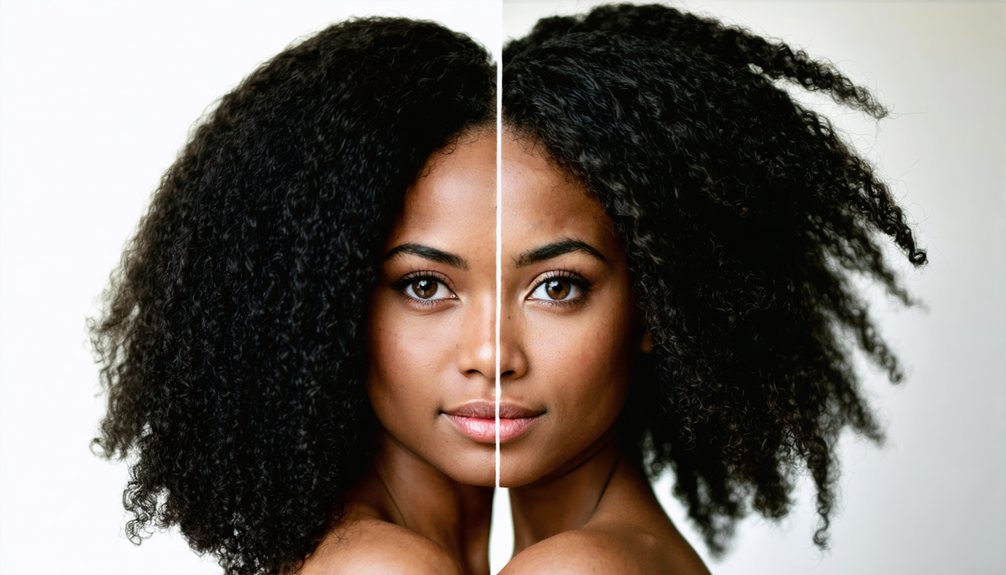

Heat damage permanently alters your hair’s internal structure — it’s not just dryness that a deep conditioner can fix. When heat breaks down keratin proteins and disulfide bonds, your curl pattern can change forever. You’ll notice signs like persistent frizz, limp curls that won’t revert after washing, and strands that snap instead of stretch. Prevention starts with proper technique and heat protectants, while recovery requires strategic trimming and a rebuilt regimen — all of which you’ll find covered ahead.
Key Takeaways
- Heat damage permanently alters hair’s protein structure, converting α-keratin to β-keratin, causing irreversible curl loss, reduced elasticity, and structural breakdown.
- Key signs include persistent dryness, straw-like texture, uneven curl patterns, excessive breakage, and sections that won’t revert after washing.
- Always apply heat protectant on damp, detangled hair before other styling products, concentrating on moisture-vulnerable mid-lengths and ends.
- Use the lowest effective temperature, keep tools moving, and never apply heat directly to wet hair to prevent steam damage.
- Recovery requires strategic trimming along the damage line, weekly protein and moisture treatments, and a 90-day heat-free regimen rebuild.
What Is Heat Damage in Natural Hair?
Heat damage in natural hair is more than just dryness or a bad hair day—it’s a permanent structural change to the hair fiber caused by excessive or repeated exposure to high temperatures. Unlike temporary dryness that responds to moisture treatments, true heat damage alters your hair’s internal architecture in ways that don’t reverse with time or conditioning.
When heat outpaces your hair’s ability to maintain its strength, flexibility, and moisture balance, the result is lasting. You’ll notice it most clearly when your natural coils or curls simply stop returning after wash day—not because they need more product, but because the fiber itself has changed. Recognizing this distinction is the foundation of protecting your natural hair.
Temperatures above 300°F cause α-keratin to β-keratin conversion, weakening the hair’s protein structure and permanently reducing its elasticity.
How Heat Actually Damages Natural Hair
When a flat iron glides across your strands, it triggers a cascade of structural events that go far beyond surface-level styling.
Heat first attacks your cuticle layer, causing scales to lift, crack, and separate. It strips the hydrophobic lipid coating that protects your fiber’s surface, leaving it porous and friction-prone.
As temperatures climb, your internal keratin begins breaking down. Disulfide bonds rupture, protein organization collapses, and flat irons can damage up to 85% of keratin proteins within affected fibers.
Meanwhile, internal moisture evaporates rapidly, generating steam that bursts through your cortex, creating voids and fractures throughout.
Once your cuticle’s compromised, damage moves inward. Your cortex weakens, elasticity drops, and each subsequent heat session accelerates the destruction already underway. Chemically treated hair is especially vulnerable because bleaching and coloring compromise the cuticle before heat is ever applied.
What Causes Heat Damage in Natural Hair?
Understanding what drives heat damage puts you in a much better position to prevent it.
Several factors work together to compromise your strands, and recognizing them changes how you approach every styling session.
Excessive temperature is the primary culprit.
Cuticle degradation starts around 150°C, with cortex damage following near 200°C.
Most flat irons and curling tools operate comfortably within that destructive range.
Frequency matters just as much.
Repeated high-heat exposure accumulates microscopic damage even when individual sessions seem harmless.
Pair that with no heat protectant, insufficient moisture, or chemical services like color or relaxers, and your hair’s tolerance drops markedly.
Your hair type also determines your risk level.
Fine strands break down faster at temperatures that coarser hair might handle, making one-size-fits-all settings genuinely dangerous.
Never apply curling irons or straighteners to wet hair, as water in wet hair can boil under heat, generating steam internally that weakens strands from within.
What Are the Signs of Heat-Damaged Natural Hair?
Recognizing the signs of heat damage early can mean the difference between a manageable setback and irreversible loss. Your hair will tell you what’s happening — you just need to listen.
Watch for persistent dryness that conditioning can’t fix, a straw-like texture, and strands that snap instead of bend. Split ends, white nodules, and short broken pieces along your lengths signal structural failure.
Excess frizz, chronic tangling, and difficulty holding styles mean your cuticles are no longer lying flat.
Dullness, faded color, and rapid moisture loss point to high porosity.
Finally, check your elasticity — healthy strands stretch and spring back. If yours snap or feel mushy when wet, your hair’s internal structure is already compromised. A simple pull test can reveal whether your strands lack the stretch and resilience of healthy hair. Don’t ignore these warnings.
How Heat Damage Affects Your Curl Pattern
Those signs — the snapping strands, the frizz, the dullness — aren’t random. They’re evidence of something deeper: structural collapse within the hair shaft itself.
When heat reaches 215–235°C, it melts the alpha-helix structure inside keratin, permanently reshaping the very architecture that gives your curls their pattern. Disulfide bonds — the stronger bonds responsible for coil formation — break. What remains can’t hold a spiral. It can’t spring back. It stays stretched.
You’ll notice it unevenly. Roots show your true pattern while heat-exposed ends run straight or weakly wavy. Some sections develop “ghost curls” — areas where the curl simply doesn’t return, even after washing. Repeated exposure mimics chemical relaxers, progressively downgrading tighter curl types into looser, elongated patterns that rehydration alone can’t reverse. Beyond the curl pattern itself, heat also compromises the cuticle layer, increasing porosity and leaving strands rougher, more prone to tangling, and less able to retain moisture over time.
How Heat Damage Changes Porosity in Natural Hair
Heat damage doesn’t stop at the curl pattern — it rewires how your strands interact with moisture at a fundamental level. When heat lifts and breaks your cuticle scales, your hair shifts from low or medium porosity toward high porosity, often unevenly. Some sections absorb water instantly while others resist it entirely — on the same head.
That rapid moisture intake sounds beneficial, but compromised cuticle and lipid layers can’t retain what they’ve absorbed. Your hair drinks fast and dries fast, staying persistently dry. Repeated swelling and shrinking cycles trigger hygral fatigue, weakening fibers progressively.
The consequences compound: reduced tensile strength, increased breakage, frizz, faster color fade, and heightened frizz in humidity. Heat damages hair by permanently altering the keratin protein bonds that give your strands their structural integrity and shape. Understanding your porosity shifts is how you reclaim control of your moisture strategy.
Can Heat-Damaged Natural Hair Be Repaired?
When heat breaks keratin bonds and denatures proteins inside the cortex, it creates structural changes your hair can’t undo on its own. Cosmetic treatments like deep conditioners, bond builders, and oil soaks can improve softness, strength, and flexibility—but they’re not restoring your hair’s original architecture. They’re managing the surface.
True repair doesn’t exist at the structural level. What does exist is a clear, empowering path forward: trim the damage. Cutting along the demarcation line between healthy new growth and compromised ends stops the breakdown and lets your undamaged hair thrive. Gradual micro-trims every six to eight weeks let you retain length while progressively removing weakened sections. Your curl pattern isn’t lost—it’s waiting in the new growth already emerging from your scalp. To support that new growth, use masks and conditioners enriched with shea butter, argan oil, coconut oil, or aloe vera to seal moisture back into your hair and encourage your natural curl to return.
How to Use Moisture and Protein Treatments on Heat-Damaged Hair
Managing heat-damaged hair well means knowing what it actually needs before you reach for any product. Perform a strand test first—gummy, overly elastic strands signal protein deficiency, while strands that snap with little stretch indicate moisture need. Heat damage often creates both, so you’ll frequently address them together.
For moisture, apply a humectant-rich deep conditioner weekly, follow with an emollient leave-in, and finish every rinse with cool water to seal the cuticle. For protein, use a hydrolyzed keratin or amino acid treatment weekly on fragile strands, then immediately follow with a hydrating conditioner to prevent brittleness.
Always clarify your hair before treatments, apply in small sections for full saturation, and allow 20–30 minutes of dwell time for real penetration. Before applying any heat tools after treatment, use a heat protectant spray on wet or dry hair to create a barrier between your strands and the heat source.
How to Use Heat Tools Without Damaging Your Hair
Once you’ve restored some balance to heat-damaged hair through targeted moisture and protein work, the next step is making sure you don’t undo that progress every time you reach for a flat iron or blow dryer.
Always start on freshly cleansed, fully dry, detangled hair sectioned into one-to-two-inch parts. Begin at the lowest appropriate temperature for your hair type—fine hair rarely needs more than 150°C, while coarser textures can tolerate up to 200°C. Keep tools moving in one smooth pass; pausing concentrates heat and burns the cuticle.
Hold blow dryers at least five inches away and finish with cool air. Every deliberate choice you make with heat is a vote for your hair’s long-term strength.
Avoid styling on hair that has product buildup from texture sprays or dry shampoos, as styling product residues heated onto the hair shaft can accelerate cuticle breakdown and worsen damage over time.
How to Apply Heat Protectant the Right Way
Before anything touches your hair, the condition it’s in when you apply heat protectant determines how well that product actually works.
Start with clean, towel-dried, damp hair—not dripping wet, not bone dry. Remove excess water with a microfiber towel, then detangle completely.
Divide your hair into four to eight sections so every strand gets covered, including your hairline, crown, and back. Apply protectant on both sides of each section. Concentrate product on your mid-lengths and ends—skip heavy application at the roots to avoid greasiness.
Hold spray bottles six to ten inches away for an even mist. For creams or serums, warm the product between your palms first. Then comb through each section until distribution feels smooth, consistent, and buildup-free. Always apply your heat protectant before curl creams or gels so it sits closest to the hair shaft where protection is needed most.
When to Trim or Cut Heat-Damaged Natural Hair
Applying heat protectant correctly buys your hair time, but when damage has already set in, no product can undo what heat has structurally broken down.
If your ends show white, frayed tips, split ends traveling up the shaft, or sections that won’t revert to their natural curl pattern, trimming isn’t optional — it’s necessary.
Mild damage with limited splits calls for strategic trims every six to eight weeks, removing roughly half an inch to one inch.
Moderate damage warrants removing one to two inches.
When breakage is widespread, elasticity is gone, and treatments consistently fail, a big chop or gradual removal of several inches every few months becomes the most effective path forward.
Cutting damaged length isn’t defeat — it’s reclaiming your hair’s integrity. Heat breaks down hydrogen and keratin bonds within the strand, which is why structurally compromised hair cannot be restored through conditioning alone.
How to Rebuild Your Natural Hair Regimen After Heat Damage
Rebuilding your natural hair regimen after heat damage isn’t about chasing a quick fix — it’s about committing to a structured recovery that addresses the real problem: compromised protein bonds, disrupted moisture balance, and a cuticle layer that can no longer protect itself.
Start by eliminating heat entirely. Clarify your hair, assess your porosity, and establish a 90-day recovery window.
Shift to sulfate-free shampoos every four to seven days, keeping water cool to reseal the cuticle. Introduce weekly protein treatments using hydrolyzed keratin, then alternate with deep moisturizing masks to maintain balance. Add bond-building treatments once weekly to restore internal structure.
Detangle only on damp, conditioned hair. Choose loose protective styles that reduce tension. Your strands are rebuilding — protect them accordingly.
To support healthy new growth throughout recovery, perform a daily scalp massage for five minutes using your fingertips — not nails — to improve circulation to the follicle.
References
- https://www.dyson.com/discover/insights/hair/health/9-signs-of-heat-damaged-hair
- https://www.healthline.com/health/beauty-skin-care/heat-damaged-hair
- https://goldielocks.com/blogs/news/heat-damaged-hair
- https://www.salonbowie.com/blog/suffering-from-heat-damaged-hair-spot-the-signs
- https://iamsandyesprit.com/2026/03/09/heat-damage-on-natural-hair-how-it-happens-and-how-to-protect-your-hair/
- https://www.ulta.com/discover/beauty-education/how-to-protect-hair-from-heat-damage
- https://www.7haircare.com/blogs/our-style/diagnose-heat-damage
- https://hairstory.com/blogs/news/heat-damage-symptoms
- https://www.wella.com/professional/en-FI/blog/hair-care/repair-heat-damaged-hair
- https://www.youtube.com/watch?v=1DL6CvHE_2w