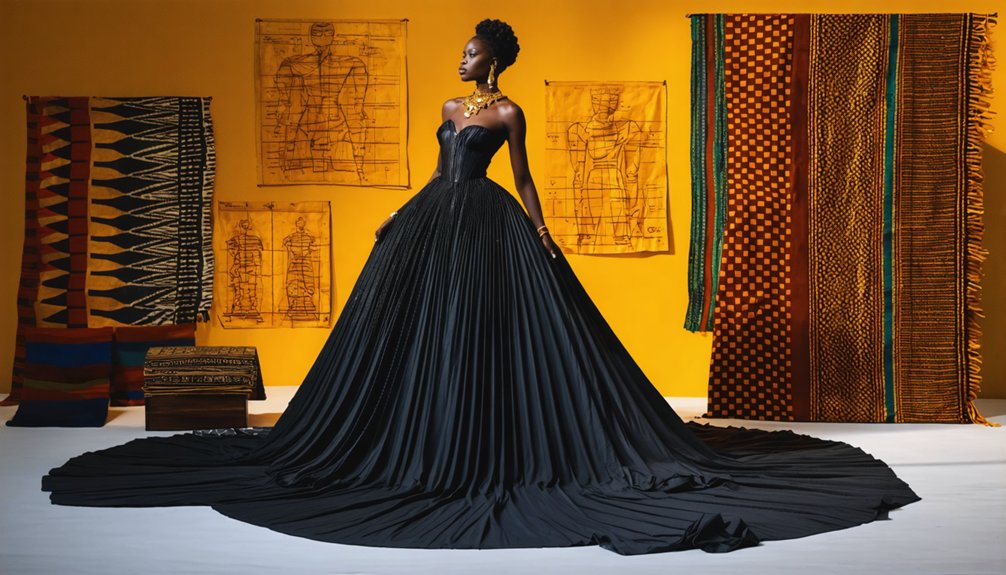

Black fashion history runs deeper than most style timelines admit. You’ll find it in Elizabeth Keckley dressing Mary Todd Lincoln, in Ann Lowe designing Jackie Kennedy’s wedding gown, and in Virgil Abloh leading Louis Vuitton. From Harlem boutiques to Paris runways, Black designers didn’t just participate in fashion — they redirected it. The full story, spanning centuries of innovation, resistance, and cultural authority, is one worth knowing completely.
Key Takeaways
- Elizabeth Keckley and Ann Lowe shaped White House fashion history despite being enslaved or marginalized, often going uncredited by mainstream press.
- Zelda Wynn Valdes dressed Black entertainment royalty and designed the first commercially patented costume: the original Playboy Bunny uniform.
- Stephen Burrows and Arthur McGee broke Seventh Avenue barriers, bringing bold Black-led design into mainstream department stores and international runways.
- Dapper Dan revolutionized street luxury by remixing European monograms into custom pieces, directly birthing hip-hop’s relationship with high fashion.
- Cross Colours, Karl Kani, and FUBU transformed Black streetwear from local cultural expression into a globally scaled, multimillion-dollar industry.
How Slavery and Segregation Shaped Black Fashion’s Hidden History
When enslavers dressed enslaved people, they did so by law. South Carolina’s 1735 Negro Act restricted fabrics to the coarsest grades—osnabrigs, kerseys, and rough cottons—while sumptuary laws banned any dress deemed “above station.” Clothing wasn’t incidental. It was a mechanism of racial control, legally encoding hierarchy into fiber and weave.
Allotments were minimal: roughly five to eight yards of cloth per year, often threadbare before the season ended. Yet enslaved people resisted. Women who spun, wove, and sewed plantation cloth found space for subtle expression. Ribbons, handkerchiefs, and improvised accessories transformed scarcity into identity.
After emancipation, Black Codes extended the same logic. Hats, shoes, and tailored garments became contested symbols—your right to wear them signaled whether liberty was real or merely nominal. Enslaved people who labored as domestic servants received markedly finer clothing than field hands, reflecting the household’s public status rather than any recognition of their own.
The Black Designers Who Dressed Presidents and Socialites
The same legal codes that once dictated what enslaved people could wear couldn’t suppress the ambition of those who mastered the needle. Elizabeth Keckley dressed Mary Todd Lincoln and Varina Davis, positioning a formerly enslaved Black woman at the center of Civil War–era image-making.
Ann Lowe designed Jacqueline Bouvier’s iconic 1953 wedding gown, outfitting the Roosevelts, Rockefellers, and DuPonts — yet mainstream press rarely credited her work. That erasure didn’t erase the legacy. Both designers developed their extraordinary craft in spite of slavery and Jim Crow segregation, leaving an indelible mark on White House fashion history.
How Zelda Wynn Valdes Put Black Fashion on Broadway
By 1948, Zelda Wynn Valdes had done something no Black designer before her had: she’d opened a boutique on Broadway. Her salon at West 158th Street wasn’t just a business—it was a statement. She dressed Ella Fitzgerald, Dorothy Dandridge, Eartha Kitt, and Josephine Baker in figure-hugging, daring silhouettes that redefined stage glamour. She later expanded into midtown with Chez Zelda, moving Black couture closer to Manhattan’s cultural center.
Then came the Playboy Bunny uniform. Valdes designed the original costume in the early 1960s—the first commercial costume registered with the U.S. Patent and Trademark Office. By 1963, she was staging runway shows at the New York Playboy Club, presenting Black-designed eveningwear on her own terms, in desegregated spaces she helped shape. Her work was also documented by photographer Carl Van Vechten, whose images captured the elegance of her designs as worn by subjects like Joyce Bryant.
How Black Designers Broke Into Seventh Avenue
Zelda Wynn Valdes proved that Black designers could command their own space—but Broadway wasn’t Seventh Avenue. Breaking into New York’s garment district required steering through a different power structure entirely.
Arthur McGee cracked that door first. In 1957, he became the first African American designer to run a Seventh Avenue studio, then led design at Bobby Brooks, Inc.—earning his title as “Dean of African-American designers.” He proved Black-led studios could thrive in mainstream American fashion.
Scott Barrie pushed further. He launched Barrie Sport, Ltd. in 1969, landed his designs at Bloomingdale’s and Henri Bendel, and opened his own Seventh Avenue showroom by 1972. His draped jersey silhouettes defined 1970s American glamour.
These weren’t exceptions. They were architects of a new blueprint. Barrie’s runway presentations featured models who boogied wildly with streetwise brashness, embodying the cultural and racial intermingling that was quietly reshaping Seventh Avenue from within.
How Burrows and Willi Smith Defined Black Ready-to-Wear
Stephen Burrows and Willi Smith didn’t just design clothes—they redefined what ready-to-wear could mean for Black designers in America. Burrows brought bold color-blocking, lettuce-edge hems, and fluid jersey silhouettes into major department stores like Saks and Bergdorf Goodman, making Black-led design commercially undeniable. His boutique inside Henri Bendel gave that vision a permanent home.
Smith, meanwhile, pushed streetwear onto the runway, building WilliWear into an accessible brand that never sacrificed credibility. Together, they established a new design language—movement-oriented, expressive, rooted in Black urban life.
Coty Awards and celebrity clients validated Burrows on fashion’s highest stages. Press consistently named both men among international ready-to-wear’s most influential forces. By 1986, WilliWear was grossing more than $25 million a year, with distribution across more than 500 stores nationwide. You’re looking at two designers who turned everyday clothing into an act of cultural power.
The Battle of Versailles and Black Fashion’s World Stage
The commercial ground Burrows and Willi Smith built at home set the stage for something far more dramatic abroad. On November 28, 1973, at the Palace of Versailles, American fashion walked into French territory and won. You need to understand what that meant. Against five elite French couturiers, five American designers—including Burrows, the only Black designer in the room—dismantled European dominance in roughly forty minutes.
Ten Black models moved with a liberating that shook that gilded theater. Bethann Hardison, Pat Cleveland, and others didn’t walk; they claimed the runway. The French presentations were elaborate. The American segment was alive. Yves Saint Laurent himself praised Burrows’s gowns.
That night, Blackness didn’t slip into luxury fashion through a side door—it redefined what luxury could look like. The entire event had been conceived by Eleanor Lambert, a fashion publicist who also founded the Council of Fashion Designers of America.
How Dapper Dan Brought Luxury to Harlem’s Streets
While Stephen Burrows and the Battle of Versailles were rewriting luxury fashion’s global hierarchy, a self-taught tailor in Harlem was pulling off something equally audacious on home ground. In 1982, Dapper Dan opened his boutique at 125th Street, running it 24 hours a day, seven days a week.
He repurposed Gucci, Louis Vuitton, and Fendi monograms into custom furs, leathers, and tracksuits that European houses never imagined for Black bodies. His clientele — rappers, boxers, hustlers — wore his pieces as declarations of power. Like hip-hop sampling, he flipped luxury’s symbols into something Harlem owned entirely. LL Cool J, Eric B. & Rakim, Big Daddy Kane — they all came to him. Dapper Dan didn’t chase luxury. He redefined who gets to wear it.
After eight years of operation, the very brands whose logos he had reimagined raided his store and pursued copyright infringement lawsuits that ultimately forced him to close.
The Black Hip Hop Designers Who Rewrote Fashion’s Rules
Dapper Dan proved that Harlem could bend luxury to its own terms — and a generation of designers took that lesson and scaled it into an industry.
Karl Kani launched in 1989, rooting hip hop silhouettes in Brooklyn street culture and taking them into 25 European countries and Japan.
That same year, Carl Jones and T.J. Walker founded Cross Colours, generating $80–100 million annually while centering racial unity and political consciousness in every stitch. Their network elevated Kani himself, proving ecosystem-building was as powerful as individual design.
Then FUBU arrived — “For Us, By Us” — embedding logo-driven sportswear directly into rap’s visual language. Together, these designers didn’t just dress a culture. They built the commercial and creative infrastructure that made Black streetwear a global industry.
Born Carl Williams to Costa Rican immigrant parents and raised in the Starrett City projects of east Brooklyn, Kani adopted his professional name at 18 after repeating a self-questioning mantra — “Can I? Can I? Can I?” — in his journal.
How Patrick Kelly and Jay Jaxon Conquered Paris
Paris didn’t hand Black designers a seat at the table — Patrick Kelly and Jay Jaxon pulled up chairs themselves. Kelly arrived around 1979, selling dresses on Paris streets before his 1985 runway debut shook the establishment. By 1988, he’d become the first American — and first Black designer — admitted to the Chambre Syndicale du Prêt-à-Porter, the governing body of French ready-to-wear.
His bold jersey dresses, embellished with buttons, hearts, and reclaimed Black imagery, doubled in sales every season. Clients included Grace Jones, Bette Davis, and Isabella Rossellini.
Jay Jaxon pushed further into haute couture’s most guarded corridors, where few Black faces had ever been. Together, they didn’t just survive Paris — they redefined what Paris could mean for Black designers everywhere. Kelly’s runway shows were held at the Louvre, cementing his status as a designer of singular international prestige.
How Black Designers Finally Got Coverage in Fashion Media
Digital platforms and museum exhibitions like FIT’s *Black Fashion Designers* have since expanded the archive, ensuring that visibility isn’t borrowed or temporary.
You’re now witnessing a narrative Black creatives are finally controlling themselves. The Black in Fashion Council, launched by Lindsay Peoples Wagner and Sandrine Charles, has formalized this momentum through a three-year commitment pledge with public accountability reporting.
Virgil Abloh and the New Wave of Black Fashion Leadership
When Virgil Abloh was appointed artistic director of Louis Vuitton’s menswear line on March 26, 2018, it wasn’t just a career milestone—it was a structural shift. He became the first African-American to lead a major French heritage house’s menswear line, stepping into the world’s most powerful luxury conglomerate as its highest-ranking Black creative.
You can trace the blueprint directly: Off-White, founded in 2013, proved Black-led streetwear could operate at luxury’s highest tier. LVMH took notice, acquiring a majority stake in 2021 and expanding Abloh’s remit across the entire group.
His work reframed authorship, remix culture, and street aesthetics as legitimate luxury tools—not concessions. That validation didn’t just open doors for Abloh. It restructured which doors existed at all. Before any of that, his 2017 partnership with Nike on The Ten redesigned ten of the brand’s best-selling sneakers and signaled to the industry that his design language had crossover power at a commercial scale.
LaQuan Smith, Sergio Hudson, and the Black Designers Leading Fashion Today
Visibility, in fashion, only matters when it compounds. LaQuan Smith built his brand in Queens at 21, trained by his grandmother, dressing Beyoncé, Rihanna, and Gaga while shipping private orders from Lagos to London. His unapologetically glamorous aesthetic has crossed into corporate partnerships with Microsoft, Samsung, and Heineken — proof that Black luxury design converts culture into commerce. Smith formally debuted his brand in 2013, rapidly earning acclaim and cultivating a devoted private order clientele that spans continents.
Sergio Hudson moved differently. After nearly a decade in Southern California and a 2013 Bravo win, he launched his ready-to-wear label and debuted at New York Fashion Week in 2020.
Then came the inauguration — Michelle Obama’s coat, Kamala Harris’s heels. That moment wasn’t symbolic. It was structural.
You’re watching designers who don’t ask for seats at the table. They’re building their own.
References
- https://nmaahc.si.edu/explore/stories/you-should-know-black-fashion-icons
- https://editorialist.com/fashion/black-creatives-in-fashion/
- https://www.youtube.com/watch?v=8IZ9wcu0YAQ
- https://edgexpo.com/2025/02/05/fashions-firsts-black-fashion-makers-influencers-and-groundbreaking-events-that-shaped-fashion-history/
- https://evergreengoodwill.org/celebrating-black-history-month-leaders-in-fashion/
- https://www.wbur.org/hereandnow/2021/02/26/black-fashion-history
- https://exhibitions.fitnyc.edu/black-fashion-designers/
- https://www.universityoffashion.com/blog/black-history-month-celebrating-black-designers-who-have-made-a-mark-on-fashion/
- https://www.universityoffashion.com/blog/celebrating-black-history-fashion/
- https://thhm.org/culture/hip-hop-fashion-month-profile-dapper-dan/