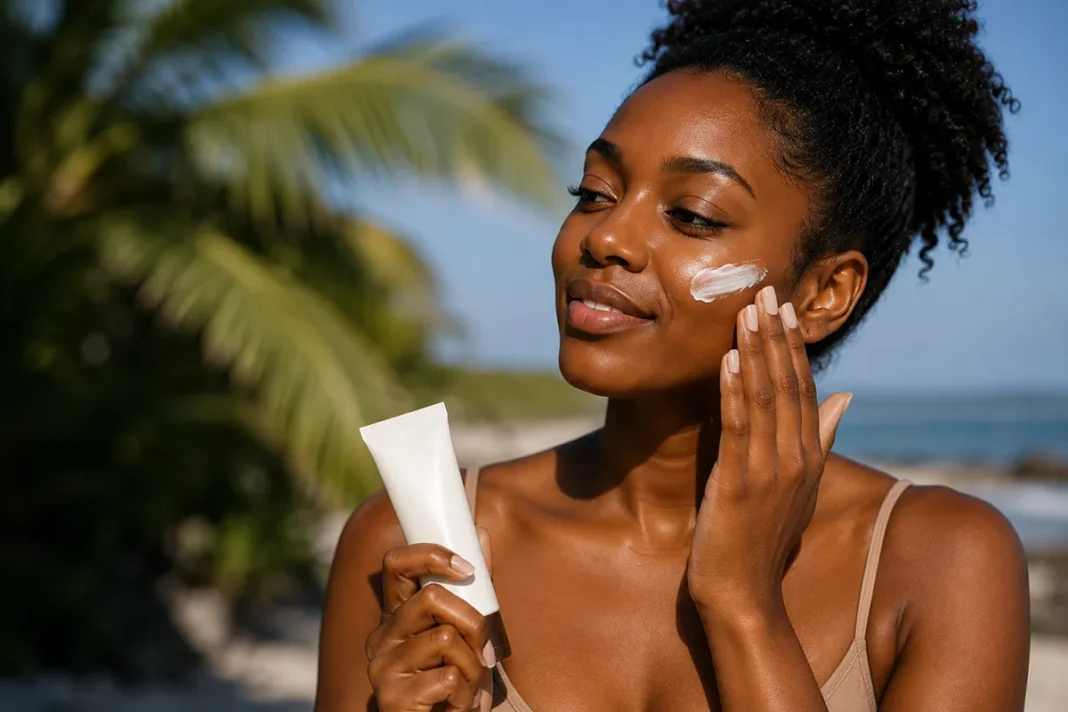

Your skin still needs daily SPF — melanin offers only SPF 4–13, nowhere near enough protection. The chalky, gray residue that puts many people off comes down to formulation, not sunscreen itself. Chemical filters, tinted hybrids with iron oxides, and micronized mineral formulas all deliver real broad-spectrum coverage without the white cast. The right combination depends on your skin type, concerns, and how you layer products — and every factor worth knowing is covered ahead.
Key Takeaways
- Dark skin still needs daily SPF 30+ since melanin only provides SPF 4–13, leaving skin vulnerable to UV damage and hyperpigmentation.
- Mineral sunscreens cause white cast by scattering visible light; chemical or hybrid formulas absorb invisibly and improve wearability on deeper skin tones.
- Tinted sunscreens with iron oxides neutralize chalky undertones while blocking visible light that worsens melasma and post-inflammatory hyperpigmentation.
- Micronized particles, lightweight textures, and proper dispersion technology reduce white cast more reliably than marketing terms like “invisible” or “all skin tones.”
- Oily skin benefits from matte, dry-touch formulas; dry skin needs hydrating creams to prevent ashiness and ensure consistent daily application.
Why Dark Skin Still Needs Sunscreen Every Day
Although melanin gives darker skin a natural advantage against UV radiation, that protection is far from limited than many people assume. Melanin offers roughly SPF 4–13—nowhere near the SPF 30 dermatologists recommend for reliable defense. UV rays still penetrate deeply, accumulating cellular and DNA damage over time.
The risks extend beyond sunburn. Skin cancers occur in darker skin, and when they do, they’re often caught at later, more dangerous stages. UV exposure also triggers hyperpigmentation, melasma, and postinflammatory dark marks that are harder to treat in melanin-rich skin. Photoaging—wrinkles, uneven texture, age spots—develops too, just later.
Daily broad-spectrum sunscreen isn’t a beauty trend for lighter complexions. It’s a non-negotiable layer of protection your skin needs regardless of how much melanin you have. Light from phones, computers, and indoor lighting can also darken spots and stimulate melanin, making sunscreen important even when you’re not outdoors.
What Actually Causes White Cast on Dark Skin?
If you’ve ever rubbed in a sunscreen and ended up looking ashen or gray, you’ve run into white cast—and it’s not random. It comes down to mineral UV filters: zinc oxide and titanium dioxide. These naturally white minerals sit on your skin’s surface and scatter visible light back toward the eye, creating that chalky, ghostly film. On deeper complexions, that reflected light contrasts sharply against melanin-rich skin, making the effect far more pronounced.
Several factors amplify the problem. Oversized or poorly dispersed particles clump together, intensifying light scatter. High-SPF formulas require heavier filter concentrations, building a thicker opaque layer. Thick, occlusive bases trap particles on the surface. And without tints or complexion-adapted pigments, the filters’ native whiteness stays fully visible on your skin. Between the two mineral filters, titanium dioxide refracts more light than zinc oxide, making it the larger contributor to visible whitening on dark skin.
Why White Cast Leads to Skipping SPF: and Why That’s Dangerous
White cast isn’t just a cosmetic annoyance—it’s a compliance problem with real health consequences. When a product leaves you looking ashy or gray, you stop using it. You apply less, skip days, or reserve SPF only for the beach. That fragmented approach leaves your skin unprotected during everyday UV exposure—the kind that accumulates quietly.
There’s also a deeper issue. Unpleasant experiences with white-cast formulas reinforce the dangerous misconception that sunscreen wasn’t made for you—and thus isn’t necessary. Melanin does offer partial protection, but it doesn’t block all UV radiation. People of color still develop sunburn, DNA damage, and skin cancer, often diagnosed at later, more serious stages.
Cosmetic failure isn’t trivial. When a product doesn’t work for your skin tone, the health cost is real. Research confirms that one in five Americans will develop skin cancer over their lifetime, making consistent sunscreen use a genuine public health priority.
Chemical vs. Mineral Sunscreen: Which Works Better for Dark Skin?
When you’re shopping for SPF, the mineral-versus-chemical debate matters more for dark skin than most product marketing lets on. Both types deliver legitimate broad-spectrum protection, and dermatology confirms comparable effectiveness against sunburn, photoaging, and skin cancer when you apply adequate amounts consistently.
The real differences show up in finish and skin response. Mineral formulas—built on zinc oxide and titanium dioxide—scatter UV but frequently leave a white or gray cast on deeper complexions. Chemical filters absorb UV and sit invisibly across every skin tone, making daily compliance far more realistic.
Sensitive skin and pigmentary conditions like melasma may favor mineral options. But for most dark skin types, chemical or hybrid formulas win on wearability—and a sunscreen you’ll actually use every day is always the right choice. Chemical sunscreens typically need about 20 minutes to absorb into the skin before they become effective.
What Iron Oxides Do That Regular SPF Can’t
Most sunscreens stop at UV. But visible light and high-energy blue light trigger hyperpigmentation too — and standard SPF formulas ignore both entirely.
That’s where iron oxides change everything. These pigments absorb and scatter visible light across the 400–700 nm range, a spectrum no conventional UV filter addresses. When combined with zinc oxide or titanium dioxide, they can block up to 98% of blue light and reduce transmitted UVA to as little as 1.5%.
The clinical results are striking. In melasma patients, iron oxide sunscreens produced a 47% reduction in pigmentation versus 23% with standard sunscreen. Iron oxides add zero SPF value — but for deeper skin tones prone to visible-light-induced pigmentation, they deliver protection that regular formulas simply can’t. Iron oxide also improves the cosmetic appeal of physical sunscreens by adding a reddish hue that reduces the white cast from zinc oxide and titanium dioxide.
How Tinted Sunscreens Fix the White Cast Problem for Dark Skin
The white-cast problem isn’t just cosmetic frustration — it’s one of the main reasons people with dark skin skip sunscreen altogether. Tinted formulas solve this by addressing both chemistry and color. Shade-matched pigments neutralize the gray or chalky undertones that traditional mineral filters deposit on deeper complexions.
Micronized filters and lightweight textures spread invisibly across your skin instead of sitting on top like chalk. The tint itself does additional work — light-to-medium coverage camouflages hyperpigmentation and uneven tone, making any residual cast virtually undetectable. You’re not just masking the problem; the formulation is architecturally different. When your sunscreen actually blends into your skin, you wear it consistently — and consistent use is exactly how protection works.
Melanin does offer roughly SPF 13 of natural protection, but that level falls well short of what’s needed to guard against UV-related dark spots, hyperpigmentation, and skin cancer risks that still affect darker skin tones.
The Ingredients That Actually Make a Difference for Dark Skin
Choosing the right sunscreen for dark skin isn’t about SPF alone — it’s about targeting the specific wavelengths that trigger hyperpigmentation in melanated skin. Visible light and long-UVA rays drive melasma and post-inflammatory hyperpigmentation just as aggressively as UVB. Your formula needs to address all three.
Look for iron oxides — they block visible light in ways standard SPF 50+ can’t. Zinc oxide delivers broad-spectrum coverage with minimal irritation. Avobenzone extends UVA protection, but only when stabilized with Tinosorb S or octocrylene. Phenylene bis-diphenyltriazine pushes coverage into the near-UV and blue-light range, measurably reducing melanin index within weeks.
Niacinamide strengthens the formula further by interrupting melanosome transfer. Combination formulas pairing antioxidants like vitamins C and E with sunscreen have shown melasma improvement in up to 75% of participants compared to sunscreen alone. These ingredients working together — not SPF alone — deliver protection built for your skin.
What Do Labels Like “Invisible” and “All Skin Tones” Actually Mean?
When a sunscreen label reads “invisible” or “all skin tones,” you’re reading a marketing claim — not a regulated performance standard. The FDA governs SPF values, broad-spectrum coverage, and water resistance — not aesthetic descriptors. “Invisible,” “sheer,” and “universal” exist outside any legal accountability, which means brands can use them without proving performance on deeper complexions.
What actually determines white cast isn’t the label — it’s particle size, dispersion technology, surface coatings, and vehicle viscosity. A product can claim “invisible” and still leave your skin ashy if the formulation relies on non-nano zinc oxide or poor dispersion engineering.
Read these terms as starting points, not guarantees. The ingredient list and formulation details tell you far more than front-label language ever will. Tinted sunscreens contain iron oxide, which can also help reduce the visible white cast while offering additional protection against visible light hyperpigmentation.
The Best Sunscreen Textures for Deep and Dark Skin Tones
Labels tell you what a brand wants you to believe; formulation and texture tell you what a product will actually do on your skin. Choose sheer chemical gels and fluids — think Supergoop Unseen-style formulas — for a truly invisible finish that doubles as a makeup primer on deeper complexions.
If you prefer mineral coverage, tinted hybrids with iron oxides offset zinc’s gray cast while defending against visible light that triggers hyperpigmentation. Oily skin thrives with matte, dry-touch textures. Dry or mature skin needs hydrating creams that prevent ashiness.
In humid heat, reach for ultralight gels. In cold seasons, swap in richer emulsions. Your texture choice isn’t cosmetic preference — it’s the difference between a sunscreen you’ll actually wear consistently and one that stays in the drawer. Daily SPF 30 blocks approximately 97% of UVB rays and outperforms sporadic use of any higher-numbered formula.
How to Apply Sunscreen Without the Ashy Residue
Even the best sunscreen formula fails if you apply it wrong. Start with a lightweight, humectant-rich moisturizer five to ten minutes before your SPF—hydrated skin lets sunscreen spread evenly instead of clinging to dry patches and turning ashy.
Use about a quarter teaspoon for your face and neck. Dot it across your forehead, cheeks, nose, chin, and neck, then press and smooth with flat fingertips or a damp sponge rather than rubbing. Blend outward into your hairline, ears, and under your chin to avoid harsh contrast lines.
Two thin passes absorb more evenly than one thick coat. Let each layer dry down fully before evaluating. That pause is what separates a seamless finish from unnecessary streaks on deeper skin tones. For even less residue, warm the product in your palms first—heat helps emulsify heavier mineral formulas so they spread more smoothly across skin.
How to Patch Test a New Sunscreen on Dark Skin
Skipping a patch test is how a promising sunscreen becomes a hyperpigmentation trigger. On dark skin, inflammation doesn’t always announce itself as redness — it shows up weeks later as a dark spot you didn’t ask for.
Choose your jawline or side of the neck as your test site. It mirrors your facial skin’s sebaceous activity and melanin density far better than your inner arm. Apply a pea-sized amount and wear it as you normally would — all day.
Watch for 24 to 48 hours initially, then repeat daily for seven to ten days. You’re monitoring texture shifts, dullness, bumps, and burning — not just visible redness. If nothing concerning appears, you’ve earned the confidence to go full-face.
Facial skin has a higher density of sebaceous glands than other test sites, making it more likely to reveal how a formula truly behaves under comedogenic stress conditions.
The SPF Criteria That Actually Matter for Melanin-Rich Skin
Most sunscreen marketing targets SPF numbers, but for melanin-rich skin, that number alone tells an incomplete story. Your melanin provides only SPF 4–13 of natural protection, so dermatologists recommend a minimum of SPF 30 daily, with SPF 50 for extended outdoor exposure.
But SPF only measures UVB protection. UVA radiation drives photoaging and pigmentary disorders that disproportionately affect darker skin tones, so broad-spectrum coverage isn’t optional—it’s foundational. A well-formulated SPF 30 with strong UVA protection outperforms an SPF 50 with weak UVA coverage in real-world conditions.
For hyperpigmentation-prone skin, add one more criterion: iron oxides. Visible light worsens melasma and post-inflammatory hyperpigmentation, and tinted iron-oxide formulas block up to 97% of that exposure while eliminating white cast. Antioxidants like niacinamide and vitamins C and E complement sun protection by neutralizing free radicals and supporting hyperpigmentation concerns.
References
- https://www.allure.com/gallery/best-tinted-sunscreens-for-dark-skin-tones
- https://www.cerave.com/sunscreen/face/hydrating-mineral-sunscreen-spf-30-face-sheer-tint-deep
- https://www.furandsilk.com/beauty/best-tinted-sunscreens-for-dark-skin-tones
- https://www.youtube.com/watch?v=WP18F89aMtc
- https://www.lorealparisusa.com/beauty-magazine/skin-care/sun-care-and-self-tanning/sunscreen-white-cast
- https://thestyleandbeautydoctor.com/2020/06/the-best-mineral-sunscreen-for-dark-skin-ive-tried-so-far/
- https://www.youtube.com/watch?v=uOhSGzNarws
- https://www.nbcnews.com/select/shopping/mineral-sunscreen-dark-skin-rcna344718
- https://www.colorescience.com/blogs/blog/tinted-sunscreen-for-dark-skin-tones-how-to-find-a-shade-that-is-not-ashy
- https://www.reddit.com/r/Blackskincare/comments/1kbgr9m/sunscreen_that_doesnt_leave_a_white_cast/