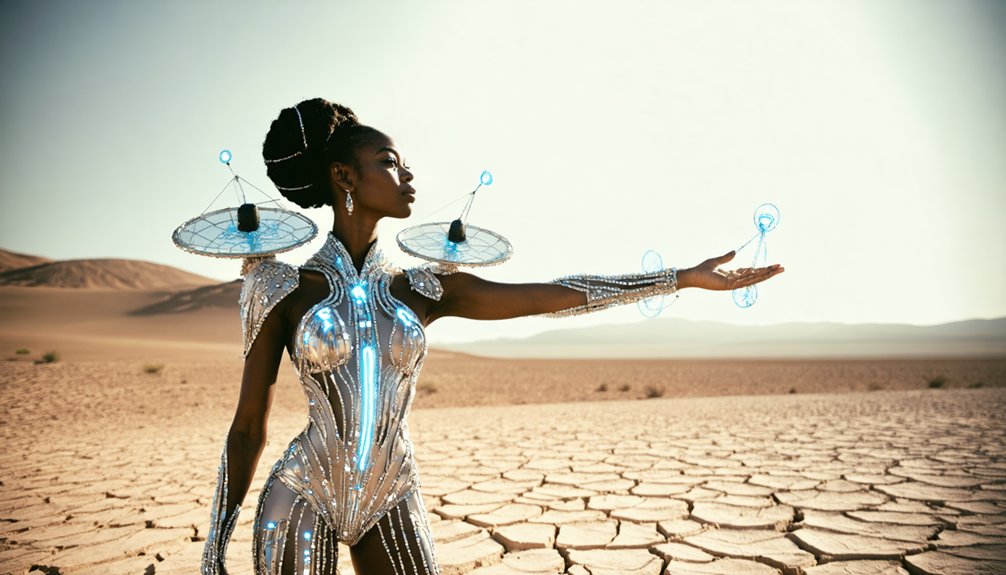

Afrofuturism is a Black-centered cultural movement fusing speculative imagination, technology, and African diasporic history into a radical act of self-determination. It’s not escapism — it’s world-building on autonomous terms. Black women have always led this movement, from Octavia Butler’s landmark fiction to N.K. Jemisin’s Hugo Award-winning trilogies, from Janelle Monáe’s concept albums to Shuri’s onscreen genius. If you think that’s the full picture, you’ve only just arrived.
Key Takeaways
- Black women like Katherine Johnson, Mae Jemison, and Octavia Butler built Afrofuturist practices before the term was formally coined in 1994.
- N.K. Jemisin and Nnedi Okofor are expanding Afrofuturism’s literary borders, earning consecutive Hugo and Nebula Awards for their speculative works.
- Afrofuturist comics and YA fiction center Black girl protagonists as inventors and resistance leaders confronting colonial violence and systemic inequity.
- Womanism provides Black women a theoretical framework to reclaim, resist, and redefine selfhood through speculative and futurist imaginaries.
- Afrofuturism functions as everyday practice—a livity—where identity, agency, and autonomy are present-tense commitments, not distant ideals.
What Is Afrofuturism and Why Does It Matter Now?
At its core, Afrofuturism is a Black-centered cultural and intellectual movement that weaves together speculative imagination, science, technology, and African diasporic histories to reimagine both the past and the future. It’s an intersection of liberation, technology, and world-building that centers your experience, your cosmology, and your autonomy.
It matters now because the systems shaping your reality weren’t designed with your autonomy in mind. Afrofuturism gives you the tools to dismantle those systems imaginatively and politically, through literature, music, film, visual art, and design. It confronts racialized histories without being imprisoned by them.
Instead, it moves forward, constructing technologically engaged, liberated futures rooted in African and Afro-diasporic thought. This isn’t escapism. It’s a radical, necessary act of self-determination. The term itself was coined by Mark Dery in his 1994 essay “Black to the Future,” which framed the movement as a way of treating African-American themes within the context of twentieth-century technoculture.
Why Black Women Have Always Led the Afrofuturist Movement
Before the term “Afrofuturism” ever entered the cultural lexicon, Black women were already building the movement—through equations that launched rockets, characters that reimagined interstellar society, and narratives that centered Black female agency in speculative worlds.
Katherine Johnson’s calculations powered NASA missions. Nichelle Nichols put a Black woman on the bridge of a starship—then recruited real astronauts to follow. Mae Jemison made it to space herself.
In literature, Octavia Butler launched Black feminist speculative fiction in the 1970s, centering Black women as architects of survival and resistance. Jackie Ormes pioneered Afrofuturist visual worlds in comics decades earlier.
Scholars confirm what the work already proved: Afrofuturism wasn’t handed to Black women—they founded it. Afrofuturism functions as a nonlinear temporal framework, allowing Black women artists and thinkers to simultaneously reckon with the past while reaching toward liberated futures. You’re not witnessing their arrival into the movement. You’re recognizing their authorship of it.
The Afrofuturist Writers Reimagining Black Futures
The writers carrying Afrofuturism forward didn’t inherit a finished tradition—they’ve been actively expanding its borders, deepening its politics, and proving its commercial and critical force. N.K. Jemisin’s *Broken Earth* trilogy won the Hugo Award for Best Novel three consecutive years, making her the first Black woman to achieve that distinction. Nnedi Okorafor coined “Africanfuturism,” centering African cosmologies rather than solely diasporic perspectives, while her novella *Binti* swept both the Nebula and Hugo Awards. These aren’t minor achievements—they’re proof that Black women’s speculative visions resonate globally.
Andrea Hairston’s *Mindscape* further pushes political and racial boundaries across altered realities. Together, these writers aren’t just participating in speculative fiction—they’re restructuring whose futures get imagined, and on whose terms. Octavia Butler, whose landmark works include *Kindred* and *Parable of the Sower*, laid much of the groundwork they build on, forging a path for nontraditional voices in science fiction during the 1970s.
How Afrofuturist Comics Put Black Girls at the Center
Comics have long been a battleground for representation, but Afrofuturism transformed that fight by placing Black girls not at the margins but at the center of entire speculative universes. Marvel’s Lunella Lafayette reframes Black girlhood through super genius science, while Riri Williams builds Iron Man-level technology from Chicago’s South Side. Writer Eve L. Ewing explicitly grounds Ironheart in Afrofuturist politics.
Stranger Comics’ Niobe Ayutami positions a brown-skinned elven girl as the savior of an entire fantasy world. The MoonGirls series deploys four African supersheroes against patriarchy, rape culture, and environmental collapse. These aren’t sidekicks. They’re architects of resistance. Afrofuturist comics introduce you to Black girl brilliance as both radical imagination and survival strategy, dismantling the dangerous myth that Black futures belong to anyone other than Black girls themselves. Ewing, who also teaches at the University of Chicago, brings her sociological research into Chicago’s South Side communities directly into Riri’s world, ensuring the character’s environment reflects the lived realities of the city she calls home.
YA Afrofuturism and the Rise of Black Girl Protagonists
These aren’t sidekicks. Zélie, Jane, and Alice are warriors, strategists, and world-changers confronting colonial violence and systemic inequity within carefully constructed speculative worlds rooted in African history, mythology, and spiritual tradition.
You’ll find their stories on every library recommendation list alongside *Raybearer* and *The Gilded Ones* — because Black girls aren’t the future of YA Afrofuturism. They’re its foundation.
Children of Blood and Bone spent over two years on The New York Times Best Sellers list, signaling an undeniable mainstream appetite for Black girl-led speculative narratives.
How Black Women Artists Built Afrofuturism’s Visual Language
Before anyone coined the term “Afrofuturism,” Black women were already building its visual language. Jackie Ormes imagined liberated Black worlds in mid-20th-century comics. Alma Thomas painted the cosmos into abstraction. Harriet Powers stitched African American mythology into quilts that pointed toward futures, not just pasts.
This lineage isn’t accidental—it’s architectural. Scholars define Afrofuturist visual language through materiality, temporality, and Black liberation, with Black women’s bodies and visions at the center. Wangechi Mutu’s cyborg collages dismantle and reconstruct the Black female form using magazine fragments, medical imagery, and car manuals. The AfriCOBRA collective codified a shared aesthetic that made Black futures legible and revolutionary.
Alisha B. Wormsley, an interdisciplinary artist, extended this visual tradition into public space with her iconic THERE ARE BLACK PEOPLE IN THE FUTURE billboards, reclaiming the urban landscape as a site of Afrofuturist declaration.
You’re not looking at art history. You’re looking at blueprints for worlds that center your liberation.
How Women Took Afrofuturist Music From Sun Ra’s Era to Janelle Monáe
Sound was always the portal. When June Tyson stood beside Sun Ra, singing cosmic mythology into existence, she wasn’t performing—she was transmitting.
Alice Coltrane extended that signal through spiritual jazz, weaving Eastern cosmologies into music that refused Western boundaries.
Then Labelle suited up in silver, Nona Hendryx wrote quantum futures into funk, and Betty Davis made transgression a narrative weapon.
Grace Jones weaponized androgyny.
Missy Elliott warped reality on *Supa Dupa Fly*, bending hip-hop’s architecture into something genuinely extraterrestrial.
Erykah Badu carried Sun Ra’s ankh-and-cosmos lineage into neo-soul.
Each woman handed the next a more refined instrument.
By the time Janelle Monáe arrived building full concept suites, Afrofuturism wasn’t underground anymore. Monáe’s sprawling narratives built on a tradition stretching back to Sun Ra’s *Space Is the Place*, where electronic experimentation first fused with Afrofuturist worldbuilding to imagine Black liberation beyond Earth’s limits.
You’d inherited a whole sonic universe—built by Black women, note by deliberate note.
How Music Videos Became Blueprints for Black Liberation
When Janelle Monáe dropped the “Q.U.E.E.N.” video, she wasn’t just releasing a visual companion—she was drafting architecture. Afrofuturist music videos now function as liberation blueprints, constructing alternate realities where Black existence is unburdened and emancipation is an everyday condition.
You’ll find cosmic imagery, speculative archives, and time manipulation rewriting distorted histories while projecting futures worth inhabiting. H.E.R.’s “I Can’t Breathe” embeds protest footage directly into the visual record, transforming a song into a living memorial.
Digital platforms accelerate circulation, expanding transnational solidarity instantly. Black women protagonists anchor these narratives, centering queerness, nonbinary identity, and Black femininity as inseparable from liberation itself.
These aren’t just videos—they’re instructions. Watch them closely enough, and you’ll find the movement already moving. In “Q.U.E.E.N.,” Monáe and Badu portrayed living museum exhibits seeking freedom, staging Black liberation as spectacle reclaimed on its own terms.
Black Women in Afrofuturist Film: Beyond Sidekicks and Stereotypes
Those blueprints drafted in music videos didn’t stay contained to three-minute loops—they migrated onto cinema screens, where the stakes of representation grew larger and the battles over who gets to occupy speculative futures became sharper.
Think about what *Black Panther* delivered: Shuri commanding Wakanda’s technological infrastructure, Okoye leading its armies, Nakia shaping its diplomacy. Black women didn’t decorate that film—they *built* it narratively. Yet even there, critics noted structural tethering to male arcs.
*The Woman King* pushed further, centering General Nanisca’s embodied authority without apology.
From Nichelle Nichols disrupting segregated casting to contemporary warrior-scientists dominating Afrofuturist blockbusters, Black women have systematically dismantled Hollywood’s sidekick ceiling—not by requesting inclusion, but by seizing the frame entirely. This evolution mirrors the broader literary lineage stretching from Samuel R. Delaney and Octavia Butler to contemporary writers like Nnedi Okorafor, whose speculative fiction laid the imaginative groundwork for the powerful Black women now commanding screens worldwide.
Afrofuturism Is a Way of Living, Not Just Looking
Living Afrofuturism means something fundamentally different from watching it. It’s a way of life — a livity — that gives your soul the conditions to move toward its fullest potential.
You’re not a passive consumer. You’re an active participant in the continuous correction of the past and the reshaping of the future. That work shows up in how you build community, how you move through your workplace, how you wear your hair, write in your journal, and show up online.
Every ritual, every creative act, every network of support you cultivate becomes a radical site of futurity. Afrofuturism asks you to center your identity, your agency, and your autonomy — not as ideals you wait for, but as practices you live now.
Scholars like Martine Syms remind us that mundane Afrofuturism resists elaborate alien tropes and instead finds its power in the quotidian rituals and inconsistencies of everyday Black life.
How Womanism Helps Black Women Claim Their Afrofuturist Identity
The practice of Afrofuturism doesn’t exist in a vacuum — it needs a theoretical home, a framework rooted in Black women’s actual lives. That’s where womanism enters.
Coined by Alice Walker, womanism centers your unique experiences, struggles, and resilience — not Western feminism’s incomplete blueprint. It grounds your identity in African culture, community, spirituality, and collective liberation. When womanism fuses with Afrofuturism, something powerful happens: you gain all-encompassing tools to reclaim, resist, and redefine your selfhood on your own terms.
Africana womanism places you at the center — from family structures to national politics — making you an architect of futurist imaginaries, not a passive subject within them. It was specifically designed for women of African descent, built around eighteen distinct characteristics that range from self-naming and self-defining to nurturing and spiritual grounding. Together, womanism and Afrofuturism don’t just imagine empowered futures for Black women. They build the ideological foundation to inhabit them.
Emerging Voices and New Frontiers in Black Women’s Afrofuturism
Black women are reshaping Afrofuturism from the inside out — breaking into mainstream literary spaces, redefining genre boundaries, and building critical frameworks that center their own experiences. N.K. Jemisin’s three consecutive Hugo Awards signaled a turning point, proving Black women’s speculative visions belong at the genre’s highest levels.
Anthologies like *A Phoenix First Must Burn* and *Black From the Future* amplify emerging voices alongside established ones, ensuring continuity across generations. Scholars like Sami Schalk and Kinitra Brooks extend these conversations into theory, connecting speculative fiction to disability, horror, and lived Black realities.
Meanwhile, artists like Janelle Monáe and Beyoncé carry Afrofuturist imagination into sound and spectacle. *Black From the Future*, edited by Stephanie Andrea Allen and Lauren Cherelle, earned a Publishers Weekly Starred Review, with critics praising it as an outstanding anthology gathering some of the best and boldest voices in African-American speculative writing. You’re witnessing a movement that’s expansive, intentional, and impossible to contain.
References
- https://sfrareview.org/2026/01/28/black-speculative-feminisms/
- https://nmaahc.si.edu/explore/stories/five-you-should-know-black-women-icons-afrofuturism
- https://www.sfomuseum.org/exhibitions/women-afrofuturism
- https://www.yesmagazine.org/social-justice/2020/04/24/how-black-women-are-reshaping-afrofuturism
- https://sanad.iau.ir/Journal/jntell/Article/907906/FullText
- https://journals.umcs.pl/nh/article/download/19792/pdf
- https://mspace.lib.umanitoba.ca/server/api/core/bitstreams/59b51a6b-596e-47b2-93f9-65381aeb0527/content
- https://larbpublab.org/2025/05/20/young-black-and-magical-the-renaissance-of-ya-afrofuturism-and-speculative-fiction/
- https://d-scholarship.pitt.edu/43532/7/Amanda_Dibando_Awanjo_Dissertation_Revised_Final_1.pdf
- https://womensmediacenter.com/fbomb/why-afrofuturism-is-a-black-feminist-praxis