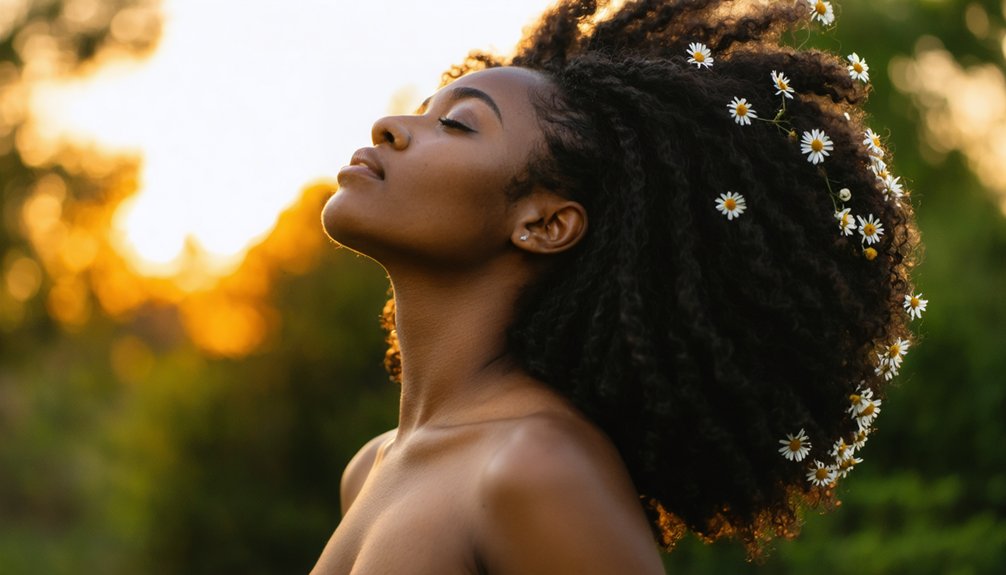

The new natural hair movement isn’t just about styling choices — it’s a full cultural reclamation. You’re witnessing Black women reject Eurocentric beauty standards, abandon health-damaging chemical relaxers, and build billion-dollar industries from the ground up. Natural styles like locs, Afros, and braids carry centuries of identity, resistance, and spiritual meaning. Yet discrimination still follows Black women into workplaces and schools. Everything from the history behind the movement to the legal battles shaping its future is worth understanding.
Key Takeaways
- The natural hair movement reconnects Black women to African diasporic identity, with styles like locs, cornrows, and Afros rejecting Eurocentric beauty standards.
- Health risks from chemical relaxers, including doubled uterine cancer risk, have accelerated the widespread shift toward natural hair care.
- Transitioning to natural hair involves strategic choices like the big chop or gradual grow-out, supported by moisture-focused, sulfate-free products.
- The movement fueled a booming $7.51 billion Black hair care market, launching Black-owned brands and massive online communities.
- Despite cultural significance, natural hairstyles still face workplace discrimination, with limited federal legal protection leaving many Black women vulnerable.
What Is the New Natural Hair Movement?
The new natural hair movement is a collective cultural shift in which Black women move away from chemical relaxers to embrace their hair’s natural afro-textured state — coiled, curly, or kinky. You’ll find it expressed through twists, braids, locs, and other protective styles that honor natural texture.
The modern resurgence began in the early 2000s, gaining momentum through social media and mainstream visibility. Unlike earlier eras, today’s movement isn’t solely rooted in overt political protest. It’s woven into everyday lifestyle choices — how you care for your hair, what products you use, and how you show up in the world.
The movement now encompasses nearly every hair-care practice except chemical relaxing, making it both expansive and deeply personal. In fact, relaxer purchases dropped 26% over a five-year period as of 2013, reflecting a significant industry-wide shift toward natural hair products and styling.
From the 1960s Afro to Today’s Natural Hair Culture
Understanding today’s natural hair movement means looking back at where it began.
In the early 1960s, figures like Miriam Makeba and Cicely Tyson brought the Afro into mainstream visibility. By the mid-1960s, it had become a declaration — a direct challenge to Eurocentric beauty standards tied to Black Power and Black Is Beautiful.
Activists like Angela Davis and Nina Simone wore their natural hair as resistance. Conservative media called it militant. The community called it liberation.
That tension never fully disappeared. Straightened styles regained dominance by the late 1970s, but natural hair reemerged with force in the 21st century. Today, you see its legacy in twist-outs, locs, and braids — styles rooted in Afrocentric identity, amplified by digital platforms, and connected to decades of resistance and self-definition. Many women are also turning to online resources to reclaim natural hair care practices lost within Black communities in the aftermath of slavery.
How Natural Hair Became a Statement of Black Identity
Black hair has never been just hair. In Wolof, Mende, and Yoruba societies, braided styles communicated your marital status, wealth, religion, and social class. Hair wasn’t decoration — it was information, identity, and belonging woven together.
That legacy carries forward. When you choose locs, cornrows, an Afro, or natural twists, you’re rejecting Eurocentric beauty standards and centering an Afrocentric identity. Scholars describe this shift as identity work, not cosmetic preference. Your hair becomes a material symbol connecting you to a collective African diasporic story.
The research confirms what you already feel. Black women who wear their hair naturally report stronger alignment between who they’re internally and how they present externally. Your hair isn’t a statement you’re making for others — it’s the truth you’re telling yourself. A 2019 Dove study found that 80% of Black women are more likely than White women to agree they have to change their hair from its natural state to fit in at the office.
Why the Natural Hair Movement Is Pushing Black Women Away From Relaxers
For generations, chemical relaxers were marketed to Black women as a grooming necessity — a straightforward solution to “manage” hair that the beauty industry had already told you was a problem.
Now, science is confirming what many of you already sensed: these products carry serious risks. NIH research links frequent relaxer use to over double the uterine cancer risk, while lye-based formulas connect to breast and hormone-dependent cancers.
Beyond cancer, ingredients like phthalates and parabens disrupt your endocrine system, threatening reproductive health from childhood onward. Relaxers also cause burns, scalp damage, and permanent hair loss.
As lawsuits mount and medical guidance sharpens, you’re no longer weighing aesthetics against culture — you’re weighing your health against an industry that never had your wellbeing in mind. Black women are nearly twice as likely to die from uterine cancer as non-Hispanic white women, a disparity researchers believe may be partly tied to unique chemical exposures like relaxers.
How Black Women Transition From Relaxers to Natural Hair
Leaving relaxers behind isn’t a single moment — it’s a process that begins the day you stop scheduling your next retouch.
From there, you face a defining choice: the big chop or the long-term grow-out. The big chop removes processed hair immediately, revealing your natural texture fast but sacrificing length. The grow-out lets you trim relaxed ends gradually over months or years, preserving length while your natural texture reclaims space.
Either path demands intentional care. Deep condition weekly, reduce shampooing, and reach for sulfate-free products and nourishing oils.
Protect the fragile line of demarcation — where your natural and relaxed textures meet — by minimizing heat and choosing low-manipulation styles like braids and twists.
Your hair is reclaiming its identity. Treat it accordingly. Stylists recommend scheduling trims every six weeks to steadily remove weakened relaxed ends and move closer to fully natural hair.
Afros, Braids, Locs, and Twists: Styles Driving the Movement
Once you’ve chosen your path — big chop or grow-out — the styles you reach for aren’t just maintenance decisions. They’re political acts, cultural inheritances, and identity statements simultaneously.
Afros carry the legacy of Black Power and “Black is Beautiful.” Braids encode lineage, protect fragile strands, and predate every dress code that’s ever tried to ban them. Locs represent long-term commitment to texture authenticity, connecting you to spiritual and Afrocentric traditions that institutions consistently misread as unkempt. Twists offer versatility while honoring your hair’s natural pattern.
Each style has faced school bans, hiring denials, and forced removals — which is precisely why CROWN legislation specifically names them as protected. When you wear these styles, you’re not just choosing aesthetics. You’re refusing a Eurocentric baseline that was never built for you.
Many Black women have embraced these natural styles after experiencing severe hair damage from repeated use of chemical relaxers and straighteners.
How Black Women’s Natural Hair Choices Built a Billion-Dollar Market
What began as a personal and political reclamation didn’t stay personal for long — it built an industry. Your collective decision to abandon chemical relaxers and embrace natural texture reshaped an entire market.
Relaxer sales dropped roughly 40% over the last decade, and that spending didn’t disappear — it redirected toward curl creams, co-washes, and moisture-rich stylers designed specifically for your hair.
The numbers confirm your influence. The global Black hair care market sits at USD 7.51 billion in 2024 and is projected to reach USD 12.67 billion by 2033.
You spend approximately six times more on hair care than other ethnic groups. That spending drives innovation, expands retail shelves, and forces an entire beauty industry to finally build products worthy of your crown.
Shampoo leads the product categories, holding 35% market share in 2023, with growth driven by sulfate-free and moisturizing formulations designed to address the unique scalp health needs of textured hair.
The Black-Owned Brands the Natural Hair Movement Made Possible
Your decision to go natural didn’t just change your routine — it created a market that Black entrepreneurs moved quickly to fill. Carol’s Daughter, SheaMoisture, Miss Jessie’s, and Curls launched before the movement peaked, building formulations specifically for coils and kinks that mainstream brands ignored. They started in kitchens and on street corners, then scaled into major retailers, television platforms, and eventually Smithsonian exhibitions.
The next generation followed that blueprint. Melanin Haircare emerged from online content. Curls Dynasty began with a home-mixed oil blend. CURLS LLC built a dedicated textured-hair business from the ground up.
Your buying power funded that expansion. Every product you chose reinforced that Black-owned brands serving Black beauty weren’t niche — they were essential, scalable, and worth billions. Founders like Beyoncé, Tabitha Brown, and Whitney White leveraged their platforms and audiences to launch brands that met the community’s needs with culturally rooted formulations.
The Online Spaces Where Natural Hair Culture Actually Lives
Before Instagram algorithms and TikTok trends, natural hair culture built itself on message boards, forums, and grassroots websites that Black women created specifically because mainstream platforms weren’t having those conversations.
Nappturality, the Long Hair Care Forum, and the Curly Nikki forums gave you real community—places where knowledge circulated openly and businesses like Oyin Handmade actually launched.
That infrastructure evolved into major editorial hubs. NaturallyCurly, Black Girl Long Hair, and 4C Hair Chicks—voted Essence’s top type 4 community—became authoritative destinations.
YouTube deepened the archive, surpassing 1.5 billion natural hair views by 2019, with creators like Naptural85 and MahoganyCurls building spaces where Black women taught each other directly.
These platforms weren’t supplemental. They were the movement’s foundation. Today, Instagram continues that legacy, where #naturalhair alone has accumulated over 72,400 uses in a single week, signaling just how actively Black women are still driving these conversations forward.
Why Natural Hair Discrimination at Work Still Targets Black Women
Even as natural hair gains cultural visibility and community infrastructure, Black women entering professional spaces still encounter a system that treats their unaltered hair as a liability.
Research confirms that natural hairstyles trigger bias, with Black women’s hair rated 2.5 times more likely to be perceived as unprofessional.
Over 20% of Black women ages 25–34 have been sent home from work because of their hair.
Legal protections remain inconsistent — Title VII case law often classifies protective styles as mutable traits, leaving braids, locs, twists, and Bantu knots largely unprotected federally.
Conservative industries impose the steepest penalties, compounding exclusion from high-status careers. Bias effects are documented as significantly stronger in industries with conservative appearance norms, such as consulting, where professional standards are benchmarked against white physical appearance.
The system isn’t ambiguous — it’s designed to penalize Blackness coded through texture, and you’re traversing it without adequate legal cover.
What the CROWN Act Does: and Where It Falls Short
The CROWN Act — short for Creating a Respectful and Open World for Natural Hair — was designed to close exactly the gap the previous section described. It prohibits discrimination based on hair texture and protective styles like braids, locs, twists, Bantu knots, and afros in workplaces and schools. California passed it first in 2019, and 27 states have followed.
But here’s the problem: you’re only protected if you live in the right state. No federal CROWN Act exists. That means your braids are legally protected in Vermont but potentially weaponized against you in Georgia.
State laws also vary in language, covered styles, and enforcement mechanisms. The patchwork creates confusion — and confusion benefits the people doing the discriminating, not you. The CROWN Act was created through a partnership between Dove, the CROWN Coalition, and then State Senator Holly J. Mitchell of California to ensure these protections became law.
How Inclusivity Debates Are Reshaping the Natural Hair Movement
What started as a collective refusal to chemically alter Black hair has grown into something more contested — and more honest. The movement now confronts its own internal hierarchies. Texturism and colorism operate inside natural spaces just as they do outside them, rewarding looser curl patterns and lighter skin while sidelining 4c textures and darker-skinned creators.
You’re navigating a beauty culture that still codes kinkier hair as a problem requiring correction. Product marketing pushes frizz control and curl definition, quietly reinforcing Eurocentric ideals under a natural hair label. Meanwhile, class gaps persist — working-class Black women remain largely absent from mainstream discourse.
Inclusivity advocates are pushing back, centering shrinkage, volume, and undefined coils as valid, beautiful, and political. That shift matters. Bald Black women and those with barber cuts or fades remain rarely seen in natural hair advertising, reflecting how far the movement still has to go.
References
- https://en.wikipedia.org/wiki/Natural_hair_movement
- https://www.marketdataforecast.com/market-reports/natural-hair-care-products-market
- https://www.researchnester.com/reports/natural-hair-care-products-market/8470
- https://market.us/report/natural-hair-care-products-market/
- https://www.grandviewresearch.com/industry-analysis/natural-hair-care-products-market
- https://scholarspace.library.gwu.edu/concern/gw_etds/qn59q415v
- https://www.bbc.co.uk/news/av/uk-england-44521629
- https://www.interfacejournal.net/wp-content/uploads/2024/11/Interface-15-1-Taylor-pre-print.pdf
- https://www.refinery29.com/en-us/natural-hair-industry-history-evolution
- https://www.elle.com/uk/beauty/hair/a69162465/straight-natural-movement/