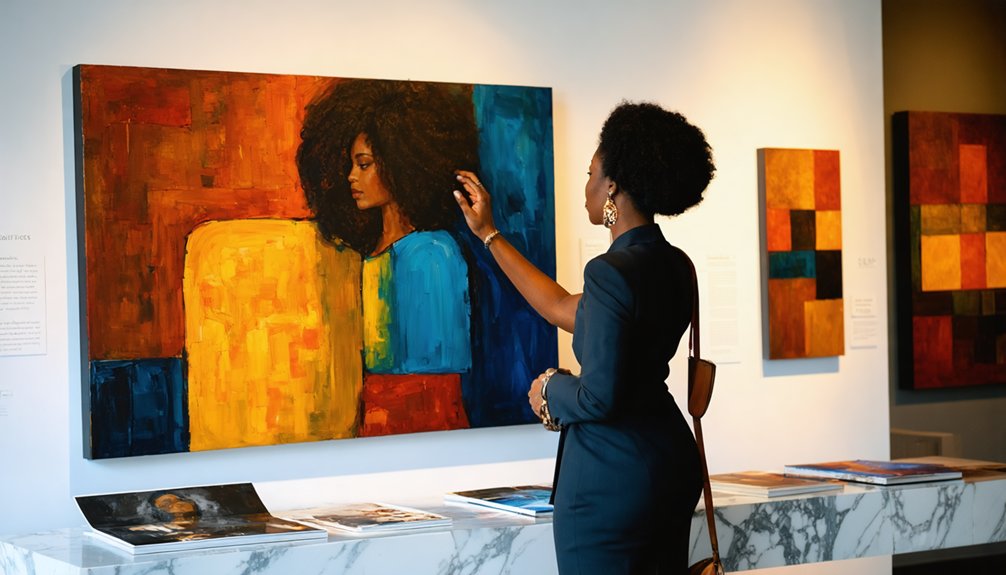

Collecting Black art means entering one of the most culturally rich and financially undervalued markets in the world. African and Black American artists combined generated over $309 million in auction sales in 2025, yet the segment remains a fraction of a $67.8 billion global market. You’re buying into real equity, deep history, and measurable upside. The fundamentals, benchmarks, and strategies you need to collect with confidence are all ahead.
Key Takeaways
- Black Art encompasses painting, photography, sculpture, and digital work centered on Black experience, culture, and identity across the African diaspora.
- Target emerging artists priced between $5,000–$50,000 with documented sell-through at reputable fairs to maximize value and minimize risk.
- Always secure clear provenance, certificates of authenticity, and condition reports to protect your investment and support future resale.
- Institutional validation—museum acquisitions, curated exhibitions, and scholarly inclusion—signals an artist’s long-term market viability and staying power.
- Attend Black art fairs and pop-up markets to compare styles, prices, and mediums from multiple artists simultaneously.
Why Black Art Is One of the Most Undervalued Markets Right Now
Despite commanding enormous cultural influence, Black art remains one of the most undervalued segments in the global art market—a gap made stark by the numbers.
Over a decade, African American artists captured just 1.2% of global auction sales. Remove Basquiat, and that figure collapses to 0.26%.
Black American women artists? A staggering 0.1%.
That’s not a market anomaly—that’s structural erasure.
You’re entering a market where value hasn’t caught up to significance. Institutions historically underfunded Black artists, leaving thin provenance chains and suppressed price histories.
Auction records remain concentrated in a handful of names, obscuring widespread undervaluation beneath the headlines. Swann Galleries remains the only major auction house with a dedicated African American Art department, a distinction it has held since 2006.
That gap is exactly where your opportunity lives—not despite the inequity, but because recognizing it puts you ahead of a market that’s only beginning to correct itself.
What Counts as Black Art and Where the Market Begins
Before you spend a dollar, you need to know what you’re actually buying. “Black Art” isn’t a monolithic category with clean edges—it’s a contested term that scholars, institutions, and markets have each defined differently, often for their own purposes.
At its core, Black Art centers Black experience, culture, and identity. It spans African, African American, Afro-Caribbean, and Afro-Latin diasporic production across painting, photography, sculpture, performance, and digital forms. Content and intent matter as much as the creator’s identity. Work that confronts racism, honors cultural memory, and resists stereotypical representation sits closest to the definition’s heart.
The market begins where institutions start framing and trading this category as distinct. Understanding that distinction protects you from buying into mislabeled work and disconnected narratives. Importantly, non-Black creators can produce work that qualifies as Black art when the content genuinely reflects Black culture and experience.
How Big Is the Black Art Market Today?
Once you understand what Black Art is, the next question is how much of it actually moves through the market—and the honest answer is: not enough, but more than ever before.
African and Black American artists combined generated over $309 million in auction sales in 2025. Black American artists alone hit $626 million in 2021—nearly 4% of the global auction market. African-born artists saw a 46% sales increase between 2013 and 2023.
Yet context matters. African art represents roughly 1% of a $67.8 billion global market. Black American artists captured just 1.9% of global auction sales over fourteen years.
The market’s growing, but it’s still undervalued—which means you’re entering at a moment of both momentum and genuine opportunity. The African art market is projected to reach around $1.5 billion in 2025, driven by collectors, patrons, investors, and an expanding calendar of international fairs.
The Representation Gap That Makes This Market Different
The numbers from the previous section tell a compelling story, but they obscure something more fundamental: Black artists aren’t just underrepresented in sales—they’re systematically underrepresented in the institutions that determine which artists matter.
Studies of major U.S. museums show Black artists comprising only 1.2–3.9% of permanent collections, despite Black Americans representing 13.6% of the population. Acquisitions tell the same story: just 2.2% over a decade.
Galleries mirror this pattern, with roughly 85% of represented artists being white. These aren’t oversights—they’re structural conditions that have historically suppressed both visibility and valuation.
Understanding this gap reframes your role as a collector. When you acquire Black art intentionally, you’re not simply buying—you’re correcting a record that institutions have been slow to fix themselves. A landmark study sampling over 9,000 unique artists across 18 major U.S. museums found that 87% of artists in those collections were men and 85% were white, underscoring how deeply demographic imbalance is embedded at the institutional level.
Which Black Artists Set the Price Benchmarks at Auction?
Auction benchmarks function as the market’s clearest language, and a handful of Black artists now speak it fluently at the highest volumes.
Basquiat’s 1982 “Untitled” sold for $110 million at Sotheby’s in 2017, setting the absolute ceiling for Black artists at auction. His roughly $2.8 billion in total sales anchors Black art firmly within the blue-chip segment.
For living artists, Kerry James Marshall’s “Past Times” reached $21.1 million in 2018, quadrupling his previous record and defining the living-artist ceiling. The work was originally purchased in 1997 by The Metropolitan Pier and Exposition Authority for just $25,000, consigned to Sotheby’s, and sold at triple the high estimate.
Mark Bradford, Glenn Ligon, and Julie Mehretu reinforce the mid-to-high range, with Bradford alone generating over $106 million in aggregate sales. These figures aren’t trivia—they’re the reference points you’ll use to assess value, negotiate confidently, and recognize when a price reflects genuine market standing.
What Auction Results Tell You About Black Art Value
Raw numbers from headline sales tell only part of the story—what’s underneath them tells you far more about how Black art actually behaves as a market.
Auction spending on Black American women’s work surged 728% between 2008 and 2021, yet that category still represents just 0.1% of total auction sales. That tension between momentum and marginalization is exactly what you need to read.
When transaction volume rises while average prices fall—as happened in 2024—it signals market correction, not collapse.
Value concentration remains sharp: the top ten African artists consistently command the majority of category revenue.
Museums are now actively competing with private collectors at auction to correct historically incomplete collections, and that institutional buying pressure is directly contributing to escalating prices across the category.
Understanding these patterns protects you from speculation and positions you to acquire intentionally, building a collection rooted in genuine cultural significance rather than reactive hype.
Where to Buy Black Art as a First-Time Collector
Knowing where to look transforms the collecting process from guesswork into strategy.
Start with dedicated platforms like The Black Art Depot, Black Art In America, and Afrikanizm, which offer curated selections across price points, including works under $100, making entry accessible. Large marketplaces like Etsy and Society6 feature Black artist categories for prints and home goods.
For deeper engagement, seek out Black-owned galleries like Skoto Gallery, Calabar Gallery, or Studio Be, where you can view work in person before committing. Hybrid spaces combining physical exhibitions with online shops bridge the gap for distant collectors.
Attend Black art fairs and pop-up markets to compare styles, mediums, and prices from multiple artists simultaneously. These spaces aren’t just transactional—they’re community, culture, and empowerment concentrated in one room. The Black Art Depot, founded in Atlanta, GA in 2004, exemplifies this mission by serving as a top supplier of African-American art, gifts, and collectibles worldwide.
How to Spot a Strong Buy in the Black Art Market
Spotting a strong buy starts with reading the signals the market has already embedded in the work. Look for artists priced within the $5,000–$50,000 range with documented sell-through at reputable fairs—that’s proof of real demand, not speculation. When a sought-after artist’s prices dip during market corrections, you’re often looking at a value opportunity hiding in plain sight.
Institutional validation matters. Museum acquisitions, curated exhibitions, and scholarly inclusion signal long-term viability. Consistent gallery placement and fair presence reflect durable interest, not hype.
Never overlook documentation. Clear provenance, certificates of authenticity, and condition reports protect your investment and strengthen future resale. In a market where non-Basquiat works represent just 0.26% of global auction value, under-recognized artists with solid fundamentals are where real equity lives.
Art historian and collector Charles Moore draws on interviews with advisors and collectors like Hill Harper and Keith Rivers to reveal the blueprint for navigating the elitist world of galleries and museums as a new buyer.
How to Build a Black Art Collection Around Diaspora Themes
Building a collection around diaspora themes means committing to a framework—one where each work earns its place by engaging migration, displacement, colonialism, or identity formation across the African diaspora’s full geographic and historical range. You’re not simply buying beautiful objects; you’re mapping a living history.
Seek artists working across Lagos, London, Dakar, and New York to reflect the diaspora’s transnational density. Balance Caribbean, Afro-Latinx, and African American perspectives alongside continental African voices. Let historical timelines guide you—from precolonial Africa through the trans-Atlantic slave trade, independence movements, and contemporary globalization.
Study collector-led ecosystems like Diasporal Rhythms and CCH Pounder’s 500-work model. Diversify mediums—photography, painting, sculpture, mixed media—so your collection mirrors the full range of how Black artists have documented, resisted, and reclaimed their worlds. The Chiaroscuro Collection by Washington, D.C.-based collector Olusanya Ojikutu demonstrates how a single focused collection can span ancient first-millennium works through 21st-century contemporary pieces while maintaining a cohesive diaspora vision.
How to Insure and Conserve Your Black Art Collection
Protecting a Black art collection demands the same intentionality you brought to building it.
Standard homeowner policies typically cap artwork coverage at US$2,500–5,000 total — dangerously insufficient for culturally significant works. Pursue a standalone fine art or personal inland marine policy with agreed-value, all-risk coverage, ensuring payouts reflect no depreciation.
Document every piece thoroughly: high-resolution photographs, dimensions, provenance, purchase records, and condition reports. Notify your insurer immediately after each acquisition, sale, or relocation. Premiums typically run 0.1–2% of insured value annually — modest protection for irreplaceable work.
For loans or exhibitions, secure nail-to-nail, worldwide transit coverage and difference-in-conditions protection to fill gaps in institutional policies. Review your collection schedule periodically, updating valuations against current market data to prevent underinsurance from quietly eroding what you’ve built.
Fine art insurance carriers also provide expert guidance on restoration, transportation, and storage, offering risk management value that extends well beyond a simple financial payout.
What Collectors Need to Know About Tax, Estate, and Documentation
Once you’ve secured your collection against physical loss, you need to protect it from financial and legal exposure — because the tax and estate implications of owning significant Black art can be just as consequential as the works themselves.
Artwork held over a year faces a 28% federal capital gains rate, with additional taxes potentially pushing that figure past 31%. At death, collections enter your taxable estate at fair market value, creating real liquidity pressure.
Strategic tools — grantor trusts, charitable remainder trusts, and pre-death transfers — can reduce that exposure materially.
Equally important: maintain meticulous documentation. Provenance records, appraisals, and purchase receipts don’t just satisfy the IRS — they affirm each work’s cultural legitimacy and protect its value for the generations you’re building this legacy for. For works appraised at $50,000 or more, collectors can request a Statement of Value directly from the IRS, providing a binding valuation that removes ambiguity and strengthens your estate position.
How to Track Artists, Revisit Prices, and Scale Your Collection
Scaling a collection with intention demands more than a good eye — it demands systems.
Start by logging every work in dedicated inventory software like Artwork Archive or Sortly, capturing dimensions, mediums, valuations, and appraisal notes in one auditable place. Tag works by artist identity, region, and subject matter so you can assess your exposure clearly.
Revisit auction prices every six to twelve months using databases like Artprice or MutualArt, which track hundreds of thousands of artists and millions of realized prices. Compare hammer prices against prior estimates to identify who’s trending, plateauing, or correcting. Artprice’s archive spans over 210,000 fine art auctions, with coverage reaching back to 1983 and select Mayer auction data from as early as 1963.
The African art auction segment grew from $33 million in 2016 to $87 million in 2022, then corrected to $44 million in 2024 — proof that conviction, timing, and data must move together.
References
- https://www.cadaonline.us/a-decade-in-review-the-african-art-market/
- https://blackartmagazine.com/commerce/art-market-report-2025/
- https://www.thebookbeat.com/bookshop/catalog/collecting-african-american-art-works-on-paper-and-canvas/
- https://arttactic.com/editorials/the-state-of-the-african-art-market-2024
- https://www.culturetype.com/2017/02/21/how-much-is-that-painting-top-25-auction-lots-by-african-american-artists-2014-2016/
- https://momaa.org/momaa-african-diaspora-art-market-outlook-2026/
- https://www.culturetype.com/2016/01/25/how-much-is-that-painting-the-10-most-expensive-black-artists-ranked-by-auction-sales/
- https://myauctionfinds.com/2018/04/09/from-170000-to-600000-record-breaking-african-american-art-sale/
- https://studioburns.media/exactly-how-underrepresented-are-women-and-black-american-artists-in-the-art-world-read-the-full-data-rundown-here/
- https://news.artnet.com/market/racial-bias-art-auction-market-672518