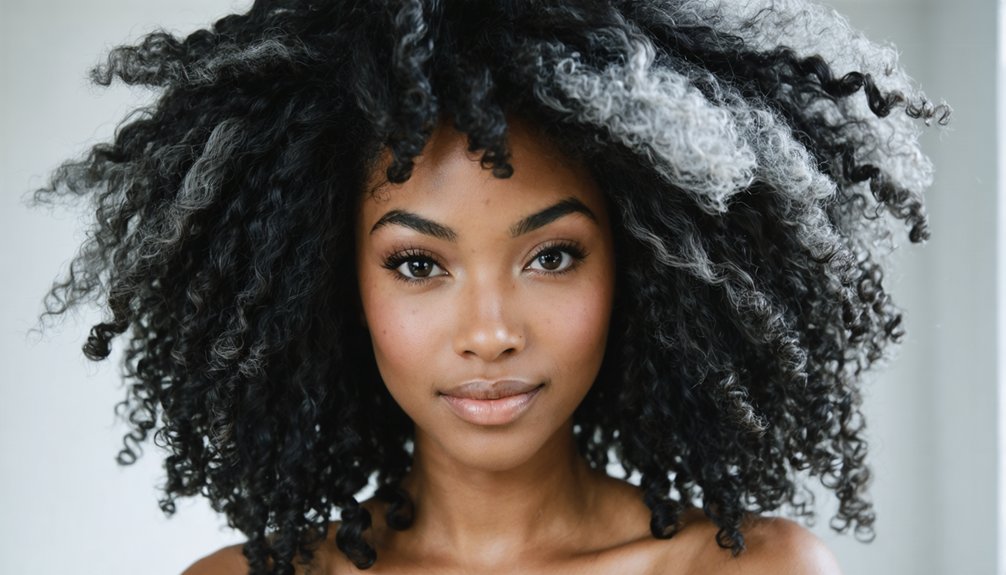

Gray blending integrates your silver strands using highlights, lowlights, glosses, and toners rather than concealing them under dense, flat pigment. It treats gray as intentional dimension — not something to hide. On African-American textured hair, your dark, richly pigmented base creates sophisticated contrast that single-process color can’t replicate. You’ll also return to the salon every 10–12 weeks instead of every 4–6. Everything from formulas to placement techniques makes this approach work beautifully for curls and coils.
Key Takeaways
- Gray blending integrates silver strands using highlights, lowlights, and toners, requiring revisits every 10–12 weeks versus full coverage’s 4–6 weeks.
- African-American hair’s dark, highly pigmented base creates sophisticated contrast, making it ideal for dimensional gray blending techniques.
- Color is placed curl by curl using diagonal subsections and herringbone patterns, softening roots while honoring natural coil definition.
- Ammonia-free demi-permanent formulas with conditioning agents like shea butter and argan oil safely blend gray without compromising textured hair integrity.
- Deep condition two weeks before your appointment and use Olaplex No.3 in the final week to reinforce bonds pre-color.
What Is Gray Blending and How Is It Different From Full Coverage?
When it comes to managing gray hair, not all color techniques are created equal.
Gray blending integrates your silver strands into the overall color design using highlights, lowlights, glosses, or toners — softening contrast rather than erasing gray entirely. The goal is a multi-dimensional, lived-in look where gray reads as intentional dimension, not something to hide.
Full coverage takes the opposite approach. It uses permanent, dense pigment applied uniformly to completely conceal every gray strand, producing a flat, one-tone result.
The core difference is philosophy: blending treats your gray as an asset worth designing around, while full coverage treats it as a flaw to mask. One liberates your natural evolution; the other fights it. With gray blending, most clients find themselves returning to the salon only every 10–12 weeks, compared to the every 4–6 week cycle that full coverage typically demands.
Why Gray Blending Works on African-American Textured Hair
Your dark, highly pigmented base isn’t an obstacle — it’s an advantage.
Babylights and lowlights create sophisticated contrast, softening the stark line between silver strands and deeper brunette or black bases. Layered tones add richness that a single-process color simply can’t deliver.
The result is a look that honors what your hair already does naturally — move, coil, and define — while integrating silver in a way that feels intentional, not accidental. Color placement is done curl by curl, respecting your natural pattern rather than working against it.
What to Tell Your Stylist Before Your First Gray Blending Appointment
The most successful gray-blending appointments don’t begin in the salon chair — they begin with the conversation you have before the first foil is placed.
Come prepared to share your full color and chemical history, including box dyes, relaxers, and keratin treatments. Describe your curl pattern, porosity, and where your gray distributes unevenly across your hairline, crown, and nape.
Tell your stylist how often you’re willing to return, what you’re budgeting annually, and whether you want a gradual shift or a faster transformation.
Clarify your visual goals using specific language — softer roots, brighter face-framing pieces, natural silver dimension. The more precisely you communicate, the more intentionally your stylist can craft a blending strategy that honors your texture, your timeline, and your terms. Ask to see photos of past blended gray work so you can align on a realistic outcome together.
How Color Placement Follows Your Natural Gray Pattern
Before a single foil is placed, your stylist should map where your gray actually lives — at the roots, along the hairline, across the crown, and through the interior sections. That distribution becomes your blueprint.
Where silver strands cluster, lighter highlights extend the brightness naturally. Where pigmented hair still dominates, lowlights preserve depth and contrast. The result mirrors what your hair is already doing, rather than overriding it.
This approach matters for grow-out, too. When placement follows your natural growth direction using diagonal, organic subsections, regrowth reads as intentional — not corrective. Fully gray sections can remain untouched while ends are adjusted to meet incoming silver.
You’re not fighting your gray pattern. You’re working with it, which is exactly where the liberation starts. A herringbone highlight technique uses a zig-zag pattern to diffuse gray roots gradually, making it a strategic option when your silver is concentrated at the hairline or crown.
The Best Gray Blending Techniques for Dark Curls and Coils
Blending gray into dark curls and coils isn’t a one-size-fits-all process — it’s a layered technical approach where formula choice, application method, and toning work together to create dimension that feels intentional.
Demi-permanent color with a low-volume developer subtly stains resistant grays without flattening your natural depth.
For denser gray zones, permanent formulas deliver the coverage you need.
Selective balayage-style placement lifts roughly 20–25% of your hair, painting lighter ribbons onto outer curls while preserving deeper lowlights beneath — amplifying volume and movement without compromising health.
Staying within two levels of your base shade keeps contrast soft and grow-out seamless.
Finishing with a cool ash or neutral-ash toner neutralizes warmth, sharpens the silver effect, and leaves your curls with brilliant, polished dimension.
Because this approach focuses on blending rather than fully covering grays, touch-up frequency is significantly lower than traditional full-coverage color — making it an ideal fit for busy schedules and naturally textured hair that thrives with less chemical exposure.
Highlights, Lowlights, or Both? How to Choose
Once you’ve locked in your technique — whether it’s selective balayage, demi-permanent staining, or a combination of both — your next decision shapes the entire visual outcome: highlights, lowlights, or a mix of the two.
Highlights lift the overall effect, making gray strands read as intentional silver. Lowlights restore depth where gray has flattened your color, adding richness without harsh contrast. Together, they create a multi-tonal, salt-and-pepper dimension that feels deliberate rather than incidental.
For dark curls and coils, cool brown lowlights paired with ashy highlights bridge the gap between your base and your gray, reducing visual contrast while keeping the result sophisticated. And because the grow-out blends into existing tones, you’re extending time between appointments — reclaiming both your look and your schedule. Strategically placed highlights can also connect directly to new gray growth, effectively disguising the hard grow-out line that would otherwise appear between your base color and incoming silver.
Which Color Formulas Are Safest for Textured Hair?
Choosing the right color formula matters as much as choosing the right technique — especially for textured hair, where porosity, curl pattern, and existing chemical history all influence how color processes, adheres, and wears.
Ammonia-free demi-permanent systems are your safest starting point. They use low-level developer to gently blend gray without aggressively lifting the cuticle, and porous, coily textures actually retain them well. For fuller coverage, ammonia-free permanent formulas — using MEA instead of ammonia — deliver up to 100% gray coverage while incorporating conditioning agents that protect curl integrity.
Prioritize formulas enriched with shea butter, argan oil, or keratin, and avoid products containing PPD if you have sensitivity concerns. Your hair deserves color that works *with* its structure, not against it. A pre-color protective cream containing panthenol and glycerin can pre-fill porous gaps before application, promoting dense, even gray coverage across coily strands.
How to Protect Your Curl Pattern Before, During, and After Gray Blending
Protecting your curl pattern through gray blending starts well before you sit in the chair. Deep condition intensively two weeks out, then again for 90 minutes on your pre-appointment wash day. Clarify one week before, but wash only three days prior to preserve your sebum layer. Use Olaplex No.3 once or twice that final week to reinforce internal bonds.
During application, request thicker sections that follow your curl pattern, minimal tension, and petroleum jelly along the hairline. Avoid overlap on previously processed hair.
Afterward, rinse with cool water, apply a rich hydrating mask immediately, and skip shampoo for 24 hours. Prioritize protein or bond-building treatments during your first two to three washes to restore elasticity and definition. Switch to a sulfate-free color-safe shampoo for all subsequent washes to remove buildup without stripping pigment from the newly processed strands.
How Toning Keeps Your Gray Blend Looking Polished
Toning is what keeps your gray blend looking intentional rather than faded between appointments. Purple and blue pigments neutralize the yellow and orange undertones that dull silver strands over time. Use a purple or toning shampoo one to two times weekly, leaving it on three to five minutes for maintenance or up to ten for stronger correction. Alternate it with a moisturizing, color-protective shampoo to protect your curl pattern and limit unnecessary dryness.
At the salon, a neutral or violet gloss applied after your color service smooths the cuticle, adds shine, and unifies your gray blend’s tone. Between visits, controlled toning prevents brassiness without creating an unwanted violet haze. Finish with clear styling products that preserve your silver reflect without staining your strands. Daily exposure to UV rays and environmental pollution can accelerate yellowing, so applying a UV-protectant spray regularly helps maintain your toned results longer between salon visits.
How Often Do You Actually Need to Come Back to the Salon?
One of the most satisfying shifts that comes with gray blending is how dramatically it reduces your time in the salon chair.
During the transformation phase, you’ll visit every three to four weeks while the initial blend is built. Once that foundation is stable, appointments stretch to eight to twelve weeks.
Post-transformation, many clients maintain their look with just four to six visits annually—compared to eight to twelve for traditional gray coverage.
If you’re comfortable letting your natural gray shine, you can push visits to every three to six months.
Some blends, particularly balayage and patina techniques, only need refreshing every six to twelve months. Between major appointments, scheduling a gloss treatment can refresh your tone and add shine for an additional four to six weeks.
Gray blending doesn’t just liberate your hair—it liberates your schedule.
At-Home Products That Maintain Your Gray Blend Between Appointments
Fewer salon visits only pay off if you’re maintaining the work between appointments. The right at-home products extend your gray blend and keep it looking intentional.
Color-depositing conditioners like Keracolor Clenditioner or Best Earth Naturals Color Boost soften contrast between brown and silver strands with each wash. For tone control, purple conditioners like Joico Color Balance or Redken’s Graydiant system neutralize yellowing that makes blend lines harsh. When you need deeper correction, semi-permanent masks like FOUR REASONS Graphite or Wella Color Fresh deposit pigment while conditioning.
For coarser, resistant grays, apply your mask to dry hair, cover with a shower cap, and process 30–40 minutes. Strand-test first, and apply longer on gray sections to maximize deposit without over-staining your pigmented strands. Color-depositing conditioners cannot lighten hair or fully transform gray hairs, so managing expectations around tone correction rather than dramatic color change is key to building an effective at-home routine.
How to Plan Your Long-Term Transition to Full Silver
Planning a long-term silver shift starts with an honest assessment of where your hair is right now. Note your current gray percentage, color history, length, and strand condition — these details shape everything.
Most transitions span 6–18 months for blending phases, extending to 1–3 years for longer lengths. Your first six to nine months typically require two to three focused appointments to manage contrast as new growth emerges. From there, you’ll gradually stretch visits to every ten to twelve weeks, shifting toward toners and occasional lowlights.
Trim every eight to ten weeks to steadily remove old color without sacrificing length. As your gray becomes dominant, artificial pigment fades from the equation. You’re not just changing your color — you’re reclaiming it on your own terms.
Many transitioners hit a common challenge point around nine months, feeling impatient or tempted to revert to dye — knowing this ahead of time helps you push through.
References
- https://www.youtube.com/watch?v=x06uyuYZCcM
- https://curlygirls.ca/grey-blending-transition/
- https://www.youtube.com/watch?v=-bZbThUrfxE
- https://www.latest-hairstyles.com/color/grey-blending-for-dark-hair.html
- https://www.reddit.com/r/curlyhair/comments/1c2qvbn/grey_blending/
- https://www.lovelyish.com/20-gray-blending-hair-color/
- https://mirellamanelli.com/how-to-blend-gray-with-demi-permanent-hair-color/
- https://www.sarastyleshair.com/post/low-maintenance-grey-blending-explained
- https://www.youtube.com/watch?v=NcVqmwXHlN8
- https://www.youtube.com/watch?v=QKW90-B7W9o