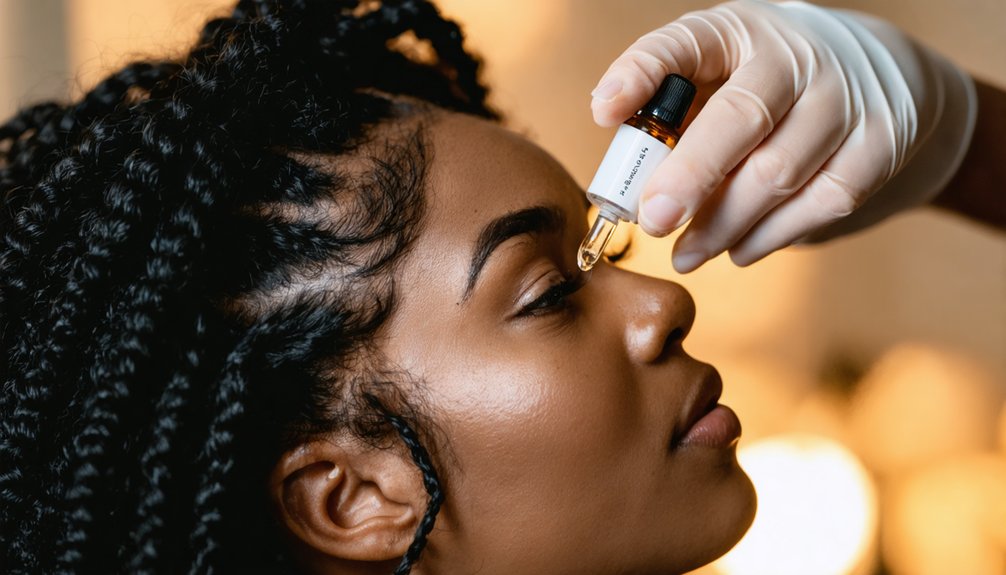

For Black women, scalp care is a medical priority — not just a beauty routine. You’re disproportionately affected by scarring conditions like central centrifugal cicatricial alopecia (CCCA) and traction alopecia, both of which can cause permanent hair loss if ignored. Your styling choices, washing habits, and chemical treatments all directly impact your follicular health. Dermatologists want you to recognize early warning signs before irreversible damage occurs — and everything you need to know is covered ahead.
Key Takeaways
- Wash coily or coarse hair every 7–14 days using a sulfate-free, pH-balanced shampoo to maintain moisture and prevent scalp inflammation.
- Tight braids, high ponytails, and lace-front adhesives cause chronic traction, leading to follicular damage and potentially irreversible scarring alopecia.
- CCCA affects Black women almost exclusively, beginning at the crown; early diagnosis is critical because scarring permanently prevents regrowth.
- Warning signs requiring urgent dermatologist evaluation include sudden shedding, smooth shiny bald patches, persistent scalp burning, crusting, or pustules.
- True protective styles must maintain low tension, allow scalp access, and be worn no longer than 2–3 months continuously.
Why Black Women Are More Vulnerable to Scalp Disease
Black women face a disproportionately high burden of scalp disease, driven by a convergence of biological susceptibility, cultural hair-care practices, and systemic underdiagnosis.
Scarring alopecias like central centrifugal cicatricial alopecia affect Black women almost exclusively, while traction alopecia impacts an estimated one-third of African American women. Chronic tension from tight braids, weaves, and relaxers compounds the damage over time.
Fungal infections and inflammatory conditions further destabilize scalp health, often coexisting with more serious conditions. Mutations in the PADI3 gene have been linked to abnormal hair-shaft protein modification and the development of scarring hair loss.
What’s most critical to understand is that widespread itching, breakage, and hair loss aren’t simply cosmetic concerns—they’re clinical signals. Because underdiagnosis remains a persistent problem, you must advocate for yourself and seek a dermatologist who understands the unique vulnerabilities your scalp faces.
How Often Should Black Women Wash Their Hair?
Few questions in Black hair care spark more debate than wash frequency—and few decisions carry more clinical weight. Dermatologists generally recommend washing every seven to fourteen days, a range that protects moisture retention while preventing scalp buildup and inflammation.
Your texture, lifestyle, and styling choices all shift that baseline. Coily, coarse hair thrives on a biweekly schedule. If you exercise frequently, shorten the interval to every five to seven days. Relaxed hair needs at least one week post-treatment before any shampooing. Protective styles like braids allow you to stretch washing to every two weeks.
Heavy product use calls for a monthly clarifying shampoo. Let your scalp—not social pressure—guide your timing. Adjust based on symptoms, not someone else’s routine. Remember that product buildup can be drying to the hair, making consistent cleansing an essential part of maintaining scalp and strand health.
How to Cleanse Without Stripping Your Scalp’s Moisture
Cleansing your scalp without sacrificing moisture starts with one foundational principle: what you use matters as much as how often you use it. pH-balanced, sulfate-free shampoos formulated for curly and coily hair lift sweat, sebum, and product buildup while preserving the scalp’s acid mantle—the protective barrier that keeps dryness and irritation at bay.
Alternate with a co-wash between shampoo sessions to maintain cleanliness without repeated surfactant exposure. Reserve clarifying shampoos for heavy buildup, and always follow with a hydrating formula to restore balance. Wash with lukewarm water, concentrate shampoo at the scalp, and use gentle fingertip circular motions—never your nails.
Let lather rinse through the lengths naturally. Finish with a cool rinse, then blot dry with a microfiber towel or soft T-shirt. Sectioning your hair before cleansing ensures even product distribution across the scalp and makes it easier to work shampoo thoroughly through each part.
Hairstyles That Quietly Destroy Black Women’s Hairlines
Some of the most beloved hairstyles in Black hair culture—cornrows, sleek buns, sewn-in weaves, lace-front wigs—carry a damaging secret: they’re quietly erasing hairlines one follicle at a time.
Tight braids and cornrows installed close to the frontal hairline exert relentless traction, triggering inflammation, follicular pustules, and eventual scarring.
High ponytails concentrate pulling at your temples daily, and gel-slicked styles lock that tension in place for hours.
Sewn-in weaves built on tight foundation braids amplify mechanical stress, especially over chemically relaxed hair.
Lace-front adhesives degrade delicate baby hairs with every application and removal.
What makes these styles dangerous isn’t occasional wear—it’s chronic repetition without recovery. Children are not immune either, as early hairstyling habits can set the stage for traction alopecia long before adulthood.
Your edges aren’t just a style detail; they’re a signal that your follicles are under siege.
Protective Styles That Actually Protect Your Scalp
Not every style that earns the “protective” label actually earns it. True protection means low tension, scalp access, and intentional maintenance — not just tucked ends and a clean part.
Flat twists, loose cornrows, two-strand twists, and halo braids reduce pulling at your hairline and crown. Wigs worn with satin-lined caps offer low-traction alternatives when you need rotation breaks. What matters is how a style is installed — no pain, no redness, no visible pulling at the roots.
Wear braided styles no longer than two to three months. Remove weaves and extensions every six to eight weeks. Cleanse and moisturize your scalp even while protective styles are in. Monitor your edges consistently.
Real protection is a practice, not just an aesthetic choice. Traction alopecia affects approximately one-third of Black American women, making it the most prevalent form of hair loss in this demographic.
What Chemical Relaxers Do to Your Scalp and Long-Term Health
Chemical relaxers work by breaking the disulfide bonds in your hair shaft using highly alkaline agents — and that chemistry doesn’t stay in your strands. With pH levels between 9 and 12, these formulas burn scalp tissue, triggering pain, peeling, inflammation, and sometimes second-degree burns. Those lesions aren’t just painful — they’re entry points. Damaged skin allows endocrine-disrupting compounds like parabens, bisphenol A, and heavy metals to absorb directly into your bloodstream.
Repeated use compounds the damage. Chronic scalp inflammation injures follicles, contributes to permanent hair loss, and has been clinically linked to central centrifugal cicatricial alopecia. Research also connects frequent relaxer use to higher rates of uterine fibroids in Black women. In one cross-sectional study, 95.56% of participants who had undergone repeated chemical hair relaxing reported experiencing at least one adverse effect. Understanding these risks isn’t fear-mongering — it’s the foundation of informed, sovereign choice.
Heat Styling Habits That Wreck Your Hair Over Time
Heat doesn’t have to be extreme to be destructive — it just has to be consistent. Every pass of a flat iron, every blow-dry session, compounds structural damage your hair can’t reverse on its own. Temperatures above 180°C convert strong α-keratin into weaker β-keratin, leaving strands brittle and snap-prone. Repeated exposure strips natural lipids, cracks the cuticle, and drops your hair’s moisture content from a healthy 13% to a fragile 5%.
For Afro-textured hair, the stakes are higher. Hot combing and frequent flat ironing don’t just damage the strand — they stress the follicle. Chronic heat near the scalp triggers inflammation, pushes hairs into the shedding phase, and quietly erodes density over months. The thinning you’re seeing now started long before you noticed it. Applying a heat protectant before every styling session creates a barrier that helps preserve the cuticle and slow cumulative moisture loss.
What Is Central Centrifugal Cicatricial Alopecia?
When dermatologists talk about hair loss in Black women, one condition commands serious attention: central centrifugal cicatricial alopecia, or CCCA. It’s the most common form of scarring alopecia among Black women, and it doesn’t reverse itself.
CCCA begins at your crown and spreads outward, systematically destroying hair follicles and replacing them with permanent scar tissue. Once scarring occurs, regrowth isn’t possible in those areas.
What makes CCCA particularly complex is its multifactorial nature. Genetics, inflammatory pathways, chemical relaxers, and certain styling practices all contribute to its development. Familial patterns suggest you may carry an inherited susceptibility.
Early diagnosis matters enormously. A dermatologist can confirm CCCA through scalp biopsy and trichoscopy, identifying active disease before irreversible damage expands further across your scalp. Over-the-counter hair loss products are ineffective against CCCA, making prescription medications the necessary standard of care for halting progression.
Early Warning Signs of CCCA and Traction Alopecia
Both CCCA and traction alopecia send early distress signals—but they’re easy to miss or dismiss as normal shedding.
With CCCA, watch for crown thinning, brittle breakage, and a widening part at the vertex. Your scalp may itch, burn, or feel tender before visible loss appears. Tiny bumps, flaking, and redness around central follicles signal active inflammation—and inflammation means a closing window for intervention.
Traction alopecia announces itself differently: broken hairs along your frontal hairline, slight recession where tension is highest, small white bumps around stressed follicles, and scalp swelling along braid rows or ponytail anchor points.
Both conditions are reversible when caught early. Recognizing these signs isn’t vanity—it’s reclaiming agency over your health before permanent damage takes hold. Once CCCA progresses, destroyed follicles are replaced by scar tissue, making hair loss in those areas permanent even after treatment begins.
How Dermatologists Treat Hair Loss in Black Women
Spotting those early warning signs is only half the equation—knowing what dermatologists actually do with that information is where real treatment begins.
For active CCCA or traction alopecia, your dermatologist will likely target inflammation first, using potent topical corticosteroids or intralesional triamcinolone injections every four to six weeks. Oral doxycycline may follow for persistent cases.
Once inflammation is controlled, topical or low-dose oral minoxidil helps stimulate whatever viable follicles remain. Adjuncts like platelet-rich plasma and low-level laser therapy offer additional support.
Here’s the critical truth: permanent fibrosis can’t be reversed, so timely intervention protects the follicles you still have. For long-standing scarring cases, hair transplantation becomes an option—but only after at least one year of confirmed disease stability.
Women diagnosed with CCCA should also be aware that the condition has been linked to uterine leiomyomas, making it important to discuss this association with your physician so appropriate screening can be considered.
Daily Scalp Habits Dermatologists Actually Recommend
Dermatologists consistently emphasize that what you do between appointments shapes your scalp health far more than any single in-office treatment.
Cleanse every three to seven days using a sulfate-free formula, letting your scalp’s feedback—itch, odor, buildup—guide your timing rather than a rigid calendar.
Massage shampoo into your roots for 30–60 seconds, rinse thoroughly with lukewarm water, and alternate full wash days with co-washes to avoid over-drying.
Keep heavy creams, waxes, and styling products off your scalp entirely.
Use a clarifying wash every two to four weeks to clear mineral and product buildup.
Sleep on satin, pat-dry with microfiber, and minimize tension from tight styles. Afro-ethnic hair grows at approximately 0.9 cm per month, slower than Caucasian hair, which means protective daily habits matter even more since recovery from damage takes significantly longer.
These aren’t suggestions—they’re the foundation your scalp’s long-term health depends on.
Which Hair Loss Symptoms Need an Urgent Dermatologist Visit
Building those daily habits creates a solid baseline—but knowing when to act fast is just as important. Certain symptoms demand immediate dermatologist attention—don’t wait.
Schedule an urgent visit if you notice any of the following:
- Sudden, rapid shedding within weeks, not gradual thinning over years
- Smooth, shiny patches where follicular openings have disappeared
- Crown-centered thinning spreading outward in a centrifugal pattern—a hallmark of CCCA, which disproportionately affects Black women
- Persistent scalp burning, tenderness, or itch in areas of hair loss
- Redness, crusting, pustules, or scaling around thinning zones
- Short, brittle hairs within bald patches signaling active follicle destruction
- Hair loss following major illness, surgery, or severe stress
Scarring alopecia is irreversible. Early intervention is your strongest protection. Scarring alopecia accounts for about 7% of people seeking care for hair loss, meaning dermatologists are well-equipped to recognize and treat it when you come in promptly.
References
- https://pmc.ncbi.nlm.nih.gov/articles/PMC12047870/
- https://www.youtube.com/watch?v=n3g5wR8ySAw
- https://pmc.ncbi.nlm.nih.gov/articles/PMC4993262/
- https://cdn.mdedge.com/files/s3fs-public/Document/September-2017/CT093060289_01.pdf
- https://www.blackhealth.org/articles/traction-alopecia-black-women/
- https://jamanetwork.com/journals/jamadermatology/fullarticle/2768748
- https://pmc.ncbi.nlm.nih.gov/articles/PMC4560533/
- https://www.drugwatch.com/hair-relaxers/
- https://www.aad.org/public/diseases/hair-loss/types/ccca/symptoms
- https://www.nbcnews.com/news/nbcblk/black-women-hair-relaxers-cancer-rcna117685