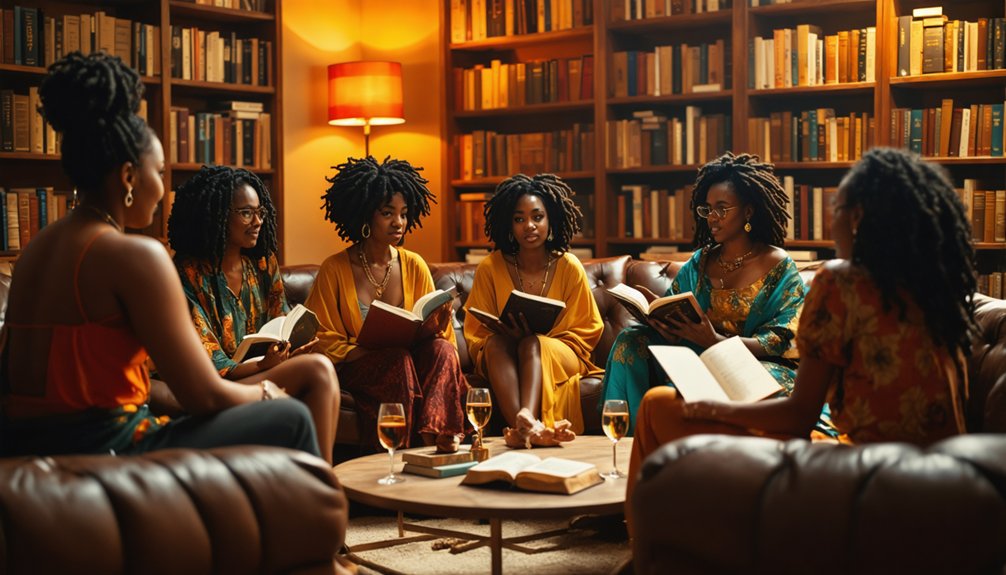

Black book clubs aren’t a new trend — they’re a revival of a tradition stretching back to the 1820s, when organized reading groups doubled as resistance movements, civic training grounds, and community lifelines. Today, digital platforms, social media, and activist-driven clubs like Noname Book Club and Well-Read Black Girl have rebuilt that infrastructure at massive scale, reshaping publishing markets and cultural power. The full story behind this movement is far richer than you’d expect.
Key Takeaways
- Black book clubs trace back to the 1820s, with over 56 literary societies operating between 1828 and 1846 across Philadelphia, New York, and New England.
- Literacy bans criminalizing Black reading between 1740 and 1834 made organized literary culture an act of radical resistance and survival.
- Black women architected book club culture, organizing literary societies as early as 1827 and nearly doubling male-organized groups by the 1850s.
- Civil Rights–era book clubs embedded inside churches, freedom schools, and Black bookstores used literature as a direct tool for political organizing.
- Digital platforms like #BookTok, Black Bookstagram, and Zoom communities have rebuilt Black reading infrastructure at unprecedented scale and reach.
Where Black Book Clubs Really Started
Black book clubs didn’t start with Oprah’s pick of the month or a viral social media post—they trace back to the literary societies that liberated Black communities built in the urban North as early as the late 1820s.
Between 1828 and 1846, at least 56 Black literary groups operated across Philadelphia, New York, and New England, linking reading directly to citizenship, resistance, and collective power.
Black women led the charge early. The Female Literary Society of Philadelphia gathered roughly 20 women weekly by 1831 to critique anonymous writings and sharpen their literary voices.
These weren’t casual gatherings—they were strategic spaces where your ancestors weaponized literacy against oppression. Every book club you join today carries that legacy forward. The Colored Young Mens Lyceum, organized around 1838, expanded this tradition by centering debates on slavery and social justice, sparking a wave of church-sponsored and private societies that followed.
How Literacy Bans Turned Black Reading Groups Into Resistance Movements
When southern legislatures criminalized Black literacy between 1740 and 1834, they inadvertently revealed exactly how much power they feared it held. North Carolina threatened 39 lashes for teaching an enslaved person to read. Georgia banned printed material outright. Virginia declared Black educational gatherings unlawful assemblies.
You need to understand what those laws actually produced: they didn’t erase reading — they radicalized it. Enslaved people stole away at night to study. They hid books in paper wrappings. They traded marbles for lessons. John Berry Meachum launched a school on a Mississippi River steamboat specifically to outrun Missouri’s ban.
When the state makes your reading criminal, your reading circle becomes a resistance cell. That’s the tradition Black book clubs inherited — and the one you’re continuing today. Before the Civil War, only 5 to 10 percent of enslaved African Americans were estimated to be literate — a number that testifies not to any lack of desire, but to the extraordinary force required to suppress it.
How Early Black Book Clubs Shaped American Civic Life
Those resistance cells didn’t stay hidden forever. By the late 1820s, Black literary societies were operating openly in Northern cities, reshaping what civic participation could look like. You weren’t just reading—you were building infrastructure. These societies maintained lending libraries, hosted lectures, established schools, and debated slavery, emigration, and self-determination with remarkable sophistication.
Organizations like Philadelphia’s Reading Room Society and the Library Company of Colored Persons combined literary culture with direct political formation. Members trained as speakers, sharpened arguments, and prepared for abolitionist work. Debates on civic questions became rehearsals for public leadership.
These weren’t casual gatherings. They were institutions—deliberately constructed to produce an informed, unified, politically conscious community capable of demanding full citizenship on its own terms. Philadelphia’s Female Literary Society, organized in 1831, held weekly Tuesday meetings where members produced and critiqued anonymous original compositions, demonstrating that Black women were central architects of this intellectual tradition.
The Black Women Who First Built Book Club Culture in America
The architects of American book club culture weren’t the women you’d find celebrated in mainstream literary histories. They were Black women — organizing in Philadelphia, Boston, New York, and Lynn, Massachusetts as early as 1827.
These societies weren’t casual gatherings. The Female Literary Association used anonymous submissions and communal critique. The Afric-American Female Intelligence Society platformed abolitionist Maria Stewart. By the 1850s, Black women’s literary societies nearly doubled those organized for men.
Their work extended beyond reading. They raised funds for antislavery campaigns, built lending libraries, and circulated original writing through the Black press — creating an interclub network that amplified their collective voice.
You inherit that legacy. Every book club conversation you join traces back to these women, who read, wrote, and organized their way toward liberation. This tradition of organized Black women’s intellectual life carried into the late nineteenth century through groups like the Colored Woman’s League, whose preamble and full constitution were formally documented in their Fourth Annual Report of 1897.
Black Book Clubs During the Civil Rights Era
By the mid-twentieth century, Black women’s literary organizing had laid a structural foundation sturdy enough to support something larger. Civil Rights–era book clubs transformed that foundation into direct political infrastructure. You’d find them operating inside churches, homes, freedom schools, and Black-owned bookstores — spaces where reading lists centered African American authors and protest literature weren’t incidental; they were intentional.
These weren’t passive gatherings. Members analyzed citizenship, employment discrimination, and access to power alongside the texts. SNCC Freedom Schools introduced youth to Black resistance narratives. Harlem’s and Detroit’s bookstore networks hosted discussions that blurred the line between commerce and organizing. Federal surveillance confirmed what participants already knew — that reading together, critically and collectively, carried genuine revolutionary weight. Your liberation has always begun with the right books in the right rooms.
The Harlem Writers Guild, founded in 1950, embodied this convergence of literary craft and political urgency, with members addressing civil rights activities like Freedom Rides and sit-ins directly in their meetings alongside the development of their work.
How Digital Platforms Sparked the Black Book Club Revival
What the Civil Rights era built in church basements and liberty schools, digital platforms rebuilt at scale.
Today, you can find your reading community through #BookTok’s 35 million posts, Black Bookstagram directories, or publisher-backed campaigns like All Ways Black—each one a curated channel connecting you to Black authors and Black readers.
The infrastructure deepened with video tools.
Zoom transformed geographically scattered readers into monthly communities.
Clubs like Mocha Girls Read blend weekly video sessions with Goodreads and Facebook engagement, layering synchronous and asynchronous discussion into something continuous and alive.
Underneath it all, Facebook groups, Goodreads threads, and Reddit communities like r/BlackReaders provide the architecture.
These aren’t casual platforms—they’re digital sanctuaries where your reading life becomes a collective, liberatory act. Mocha Girls Read extends this spirit through monthly giveaways on Facebook and Instagram, rewarding readers simply for showing up and participating in the conversation.
Well-Read Black Girl and the Online Reading Revival
Glory Edim’s Brooklyn-based book club began in 2015 as something deceptively simple: a social media reading network where comment threads turned into in-person gatherings of Black women readers and writers. That intimacy scaled into something transformative.
Today, Well-Read Black Girl operates as a full literary ecosystem — festival, podcast, published anthology, and a global online community exceeding half a million followers. The 2018 anthology earned an NAACP Image Award nomination. The podcast extends the mission weekly through conversations with authors, booksellers, and literacy advocates.
Chapters now anchor independent bookstores nationwide, meeting monthly in hybrid formats that blend in-person and virtual access. You’ll find the mission consistent everywhere: uplifting Black women’s narratives, addressing publishing inequity, and proving that Black women’s stories carry universal weight. Readers are encouraged to engage further by subscribing to the newsletter, which delivers virtual book club updates, reading recommendations, and exclusive podcast access directly to members.
Noname Book Club and Political Literacy Behind Bars
Conviction drives the Noname Book Club in ways that most reading communities never attempt. Founded in 2019 by Chicago rapper Noname, this worker cooperative sends roughly 1,000 books monthly to incarcerated readers across 37 states and 300 correctional facilities. You’ll find radical texts by Black, Indigenous, and other writers of color inside every package, accompanied by reading questions that sharpen political analysis.
The Radical Hood Library in South Los Angeles anchors this infrastructure, occupying a former furniture store where volunteers pack shipments and track prison chapters on a wall map dotted with red flags. Funded through donations, Patreon, and library sales, the program bridges carceral and non-carceral communities through shared study. This isn’t charity — it’s collective liberation built one book at a time. Beyond the prison program, book club chapters meet across 14 cities nationwide, creating local nodes of political reading and community accountability.
Why Publishers Can No Longer Ignore Black Book Clubs
The numbers have finally caught up with publishers. Early Black literature clubs attracted more than 150,000 members in just over a year. Simon & Schuster launched Inkwell Book Club explicitly to harness African-American purchasing power. These aren’t coincidences—they’re market corrections.
When organized Black readerships champion a title, orders spike. When clubs like Essence Book Club or Black Expressions endorse an author, careers transform. Publishers now align acquisition decisions with proven demand from these communities because ignoring that demand costs them money.
You’re part of something that moves markets. Black book clubs have pushed mainstream publishers to actively seek more works by and about African Americans. Your collective reading habits aren’t just cultural practice—they’re economic leverage, and the industry has finally acknowledged it can’t afford to look away.
In South Africa, book clubs have become engines of a burgeoning literature culture, proving that Black communities engage deeply with books when relevant offerings exist. Black-owned publishers like Black Bird Books and Vhakololo Press have stepped in to ensure those offerings reflect the lived experiences of their readers.
The Oldest Black Book Clubs Still Running Today
Behind that market power lies something older and more durable than sales figures—a tradition of organized Black reading that stretches back more than a century. You’re inheriting a lineage, not joining a trend.
Pittsburgh’s Aurora Reading Club has gathered Black women since 1894, predating the National Association of Colored Women’s Clubs. Charleston’s Phyllis Wheatley Literary and Social Club has sustained literary programming since 1916. Newark’s Bibliophiles, Inc., founded in 1987, holds recognition as the oldest continuously operating incorporated Black book club in America, sparked directly by Toni Morrison’s *Beloved*.
These clubs survived segregation, cultural erasure, and institutional neglect because their members understood something essential: reading together is an act of collective survival. That’s the foundation today’s revival is building on. Founded in 1991 in New York, Goon Girl Book Club now operates 30 chapters across 15 states and the District of Columbia, demonstrating how that foundation continues to expand.
How Queer and Trans Black Readers Are Reshaping the Book Club
Reshaping the book club from within, Black queer and trans readers aren’t waiting for mainstream literary culture to make room—they’re building their own. Clubs like OKHA, Black Power Book Club, and Ashes & Ink center African, Caribbean, and Afro-Latinx queer voices while establishing explicit membership boundaries that protect community safety. These aren’t neutral literary spaces—they’re sites of political education and collective liberation.
You’ll find formats designed for access: hybrid gatherings, Zoom meetings, silent reading meetups, and book swaps that connect readers across geography. Organizations like Well-Read Black Girl and Queers of Color embed trans, nonbinary, and queer narratives into every reading list—not as occasional inclusions, but as the standard. Black queer and trans readers aren’t diversifying the book club. They’re fundamentally redefining what it’s for. The Black Queer & Intersectional Collective, a grassroots organization in Central Ohio, exemplifies this through its monthly book club reading Audre Lorde’s Sister Outsider, a space open exclusively to those who identify as both Black and LGBTQIA+.
How to Find and Join Black Book Clubs Online and in Your City
Finding your people starts with knowing where to look. The African American Literature Book Club (AALBC) maintains a national database searchable by city and state—your fastest route to local and virtual groups. For cities like Washington, DC, dozens of options appear instantly.
Meetup hosts active Black-focused clubs like the African Diaspora Book Club and Diaspora Reads, offering in-person, virtual, and hybrid formats. Bookclubs.com connects you to curated spaces like THE Virtual Book Club For Black Women.
For community rooted in literary and cultural power, Well-Read Black Girl’s global network and AALBC’s #readingblack initiative connect reading to economic action—supporting Black authors and independent booksellers simultaneously.
Search intentionally. Choose the format that fits your life. Then show up consistently. Denver’s Black diaspora community, for example, gathers through a local book club that reads works by Black authors across every genre, from sci-fi and fantasy to biography and non-fiction.
References
- https://bookriot.com/a-history-of-book-clubs/
- https://www.rd.com/list/online-book-clubs/
- https://www.miaminewtimes.com/arts-culture/six-best-online-book-clubs-literally-dead-noname-unfriendly-black-hotties-11724291/
- https://www.youtube.com/watch?v=_4SBf1hthLk
- https://theeditingco.com/blog/the-radical-history-of-book-clubs-connecting-us-through-literature
- https://www.youtube.com/watch?v=5fSWQQnigLQ
- https://reedsy.com/discovery/blog/book-clubs
- https://books.google.com/books/about/Forgotten_Readers.html?hl=et&id=YXxMFuDOm-wC
- https://www.bustle.com/entertainment/best-online-book-clubs
- https://www.goodhousekeeping.com/uk/lifestyle/editors-choice-book-reviews/a32739239/online-book-club-to-join/