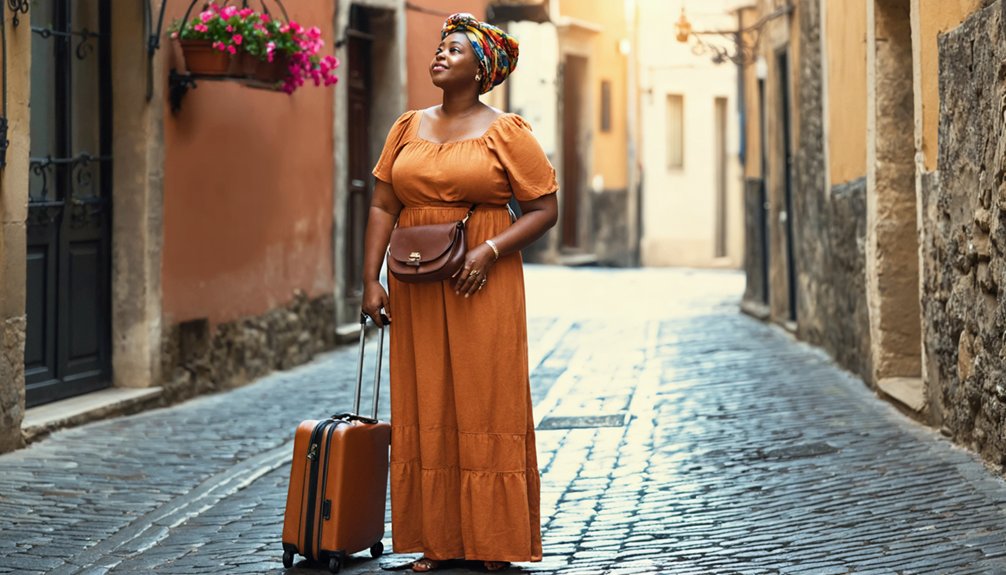

Solo travel as a Black woman means planning for both joy and the realities of compounded racial and gendered risks. Before you book, research destination-specific racism, consult government travel advisories, and cross-reference hate crime data with crowd-sourced reports. Join Black women travel communities for candid, lived-experience advice. Vet accommodations, secure your documents, and build in flexibility. Trust your instincts — they’re a legitimate safety tool. Everything you need to plan smarter and travel richer is ahead.
Key Takeaways
- Research destinations using government travel advisories, hate crime statistics, and crowdsourced tools to assess racial discrimination risks before booking.
- Join Black women travel communities like Black Girl Solo Travels or Picky Girls Travel Solo for real-time destination warnings and candid advice.
- Build a pre-trip safety checklist covering daylight arrivals, vetted transport, offline emergency contacts, and cancellable accommodations with flexible buffer days.
- Trust bodily instincts as valid threat signals; when uneasy, leave immediately, move to crowded well-lit spaces, and cancel bookings if needed.
- Secure travel insurance, carry encrypted devices, use a VPN, and document any incidents with photos, receipts, and written notes.
The Specific Safety Risks Black Women Face Traveling Solo
Traveling solo as a Black woman means maneuvering a distinct set of risks that sit at the intersection of race and gender—risks that standard solo travel advice rarely addresses.
You’re steering through racial bias in public spaces, microaggressions from service staff, and the exoticization that follows Black women into tourist zones.
You’re also managing gendered threats: street harassment, drink spiking, and opportunistic assault.
Simultaneously, your solo status marks you as a target for theft, scams, and economic exploitation.
These risks don’t operate independently—they compound. A dismissive host slows your access to help. A fetishizing stranger escalates. A distracted moment costs you your wallet.
Researching your destination’s cultural attitudes toward race and gender before departure gives you a critical advantage in anticipating how these risks may show up in specific places, so registering your trip with the U.S. State Department’s STEP program ensures you receive timely alerts about emerging threats on the ground.
Knowing what you’re actually up against isn’t fear-mongering; it’s the foundation of every smart decision you’ll make on the road.
Which Destinations Are Actually Safer for Black Women?
When safety is the filter, not every destination that looks good on a travel influencer’s feed actually holds up. You need data, community testimony, and cultural context working together.
Iceland, Norway, New Zealand, and Japan consistently rank at the top of the Global Peace Index. Portugal draws Black solo women specifically for its low crime and genuinely warm locals. Singapore, Malta, and Luxembourg offer structured, easy-to-navigate environments with minimal street risk.
On the African continent, Mauritius leads the Global Peace Index rankings, while Kigali stands out for its order and cleanliness. Ghana, Senegal, Tanzania, and Namibia all carry strong reputations within Black travel communities.
In the Caribbean, Eastern islands like St Kitts and Anguilla feel intimate and safe. Dubai ranks as the world’s safest city for solo women overall.
For Black women easing into solo travel closer to home, New Orleans consistently surfaces as a beginner-friendly first trip, offering constant street-level activity through music, food, and people that naturally reduces the feeling of traveling alone.
How to Research Racism and Inclusivity Before You Book
Safety scores and peace rankings only tell part of the story. Before you book, dig into government travel advisories specific to your destination — look for language about racial profiling, ID checks targeting certain groups, and weak enforcement of anti-discrimination laws.
Cross-reference hate crime statistics from national agencies, but understand their limits: underreporting is widespread, and numbers rarely capture daily indignities. Crowd-sourced tools like Numbeo offer resident-reported discrimination data that fills some of those gaps.
Scan local news and human rights organization reports for recent incidents involving police violence or systemic racism. Research how communities that resemble you’re treated on the ground. In Canada, for example, race or ethnicity accounted for the largest share of police-reported hate crimes in 2024, with 2,377 incidents — yet self-reported surveys suggest only about 22% of perceived hate incidents ever reach police.
Register with your embassy’s alert program, save consulate contacts, and approach every destination with eyes wide open — not fear, but informed clarity.
Black Women Travel Communities Worth Joining Before You Go
Research arms you with facts — but community gives you something no database can: lived experience, real-time warnings, and the kind of candid advice that only travels openly between Black women who’ve been there.
Before you book, join at least one.
Picky Girls Travel Solo and Black Girl Solo Travels offer destination-specific intel from women who’ve moved through those spaces as you will. She Travels the Globe and Solo Sistas are strong for inspiration and peer support. If you want structured experiences, Black Girls Travel Too, Sisters Traveling Solo, and Travel Divas curate group trips built around sisterhood. Nomadness Travel Tribe bridges both worlds — community and movement.
These spaces don’t just inform your trip. They remind you that you’ve never actually been going alone. For a community rooted in purpose, Brown Girls Travel began as an Instagram account in January 2015 and has since grown into a movement that has changed the lives of hundreds of women through group travel experiences.
Your Pre-Trip Safety Checklist as a Black Woman Traveling Solo
Before you leave, build a checklist that accounts for what general travel advice routinely omits. Research your destination’s racism and colorism patterns specifically—Black women have faced racial slurs, nonconsensual photography, and being misread as sex workers across multiple countries. Read accounts from Black women travelers, not just mainstream safety rankings.
Vet your neighborhood using GeoSure’s district-level scoring and confirm 24/7 reception and secure building access directly with your property. Schedule daylight arrivals, pre-book vetted transport, and save local emergency numbers offline.
Cross-reference real-time alerts through apps like Sitata or WanderSafe, which offer women-focused risk context. Your safety infrastructure isn’t paranoia—it’s preparation. You deserve to move through the world with both confidence and clear-eyed awareness of what you’re walking into. Racial incidents have occurred even in busy public markets, such as a vendor in Marrakesh’s Jamaa el Fna shouting a racial slur at a group of Black travelers after being turned down.
What Documents, Insurance, and Registration You Actually Need
When it comes to international travel, paperwork isn’t bureaucratic noise—it’s your first layer of protection. Carry a passport valid at least six months beyond your return date, confirm visa or electronic authorization requirements before departure, and keep both digital and printed copies of every critical document.
Secure thorough travel insurance covering emergency medical care, evacuation, and trip interruption—some countries require proof of coverage for entry. If you take prescription medications, carry a physician’s letter explaining your regimen.
Register with your government’s traveler enrollment program before you leave. It connects you to embassy support during emergencies, civil unrest, or natural disasters. Traveling unencumbered means moving prepared. The right documents don’t restrict your freedom—they defend it when systems that weren’t built for you decide to push back.
If you plan to drive at your destination, obtain an International Driver’s Permit through the American Automobile Association or American Automobile Touring Alliance before departure.
How to Choose Accommodation That Actually Feels Safe for Black Women
Where you sleep shapes everything else about your trip. Choose neighborhoods that are well-lit, commercially active, and documented as low-crime — not just on paper, but in recent reviews from Black women travelers. Prioritize properties with 24/7 staffed reception, key-card elevator access, and explicit anti-discrimination policies backed by real staff training.
Request a room between the third and sixth floors, near the elevator, never at a corridor’s end. Avoid ground floor entirely. At check-in, have your room number written, not announced. Request two key cards to signal shared occupancy.
Research how local laws and cultural norms around race and gender may affect your experience near the property. Your accommodation isn’t just shelter — it’s your base of power. Choose accordingly. Once settled, count the doors to the nearest emergency exit stairway so you can navigate safely in the dark or during an unexpected evacuation.
Getting Around Safely as a Black Woman Traveling Solo
Your accommodation anchors your trip, but your safety beyond it depends just as much on how you move. Pre-book licensed airport transfers, skip the touts, and walk directly to regulated counters or designated pick-up zones.
For taxis and ride-shares, verify the plate, model, and driver photo before you get in—then let the driver state your name. Sit rear passenger side, share your live route with a trusted contact, and never disclose your solo status. Be aware that rideshare insurance coverage shifts depending on the phase of your trip, so documenting any incident with screenshots of your ride receipt and photos of the scene is essential.
On buses and trains, position yourself near drivers, conductors, or other women and families, keep bags on your lap, and use women-only cars where they exist. Stay alert on longer journeys.
Every leg of your trip deserves the same deliberate, protective energy you brought to choosing where you sleep.
How to Read Your Surroundings and Avoid Being Targeted
Staying safe on the move means reading every environment before it reads you. Scan entrances, exits, alleys, and side streets continuously—these reveal isolation points and escape routes before they become relevant. Notice crowd density, lighting, and who’s lingering. Repeated appearances, excessive focus on bags, or someone tracking your movement deserve immediate attention.
When surroundings grow sparse or tense, correct course toward busier, more public spaces without hesitation.
Project confidence through purposeful pace, upright posture, and direct carriage. Avoid flashy accessories and align your clothing with local norms—blending in is strategic, not limiting. Keep your phone pocketed while walking, pre-load your route, and check directions inside shops rather than mid-sidewalk. You’re not lost. You’re deliberate. That distinction matters everywhere you go. Register with STEP to receive government-issued travel alerts and safety updates specific to your destination.
Protect Your Money and Valuables as a Solo Black Woman Traveler
Protecting your money and valuables starts before you leave home—with deliberate decisions about what you carry and where you keep it. Split your cash, cards, and ID across a money belt, hotel safe, and front pocket. Never consolidate everything in one place. Wear a slim under-clothing money belt during transit and in crowded areas, and choose RFID-blocking pouches to counter contactless skimming.
Use bank-branch ATMs in well-lit indoor locations, always covering your PIN. Keep daily cash modest and rely on cards for larger purchases. Store your passport and backup card in your room safe when you’re out.
In high-risk areas, carry a decoy wallet. Your liberty of movement depends on staying financially protected and operationally prepared at every stage of your journey. If you go swimming at the beach, never leave your phone or money belt hidden on the shore unattended—use a small waterproof pouch so your valuables can stay with you in the water.
How to Stay Connected and Protect Your Data Abroad
Financial security keeps your journey moving, but digital security keeps your identity and privacy intact. Before you leave, update every device, enable full-disk encryption, and strip your phone and laptop of nonessential financial, health, and work data.
Abroad, skip public Wi-Fi for anything sensitive. Use your mobile data, a personal hotspot, or a reputable VPN when connecting to hotel or café networks. Disable Bluetooth, NFC, and Wi-Fi when they’re not active. Never charge through public USB stations — carry your own adapter or a USB data blocker to prevent juice jacking.
Lock your devices with a strong PIN or password, set a short auto-lock timeout, and hide lock-screen notification previews. Avoid accessing banking systems on phones while traveling abroad, and carry physical payment alternatives as a backup. Your data is your sovereignty. Protect it accordingly.
Trust Your Gut and Know When to Change Your Plans
Your instincts are a precision instrument — and for Black women traversing complex racial and social dynamics abroad, they’re one of your sharpest safety tools. Persistent bodily tension, sudden dread, or unease around specific people aren’t overthinking — they’re data. Trust them.
Build flexibility into your trip from the start. Book accommodations with complimentary cancellation, keep buffer days open, and share your itinerary with trusted contacts. That structural freedom lets you move quickly when something feels off.
Know your red flags: racial slurs, aggressive boundary violations, inconsistent stories from drivers or hosts, poor lighting, coercive group dynamics. When those signals appear, leave without explanation.
Move toward crowded, well-lit spaces. Block contacts. Cancel bookings. Your comfort and safety are never worth sacrificing for politeness. Researching cultural norms beforehand helps you distinguish genuine risk from unfamiliar behaviors so your instincts stay calibrated rather than overloaded.
References
- https://www.melaninbasecamp.com/trip-reports/2025/4/29/traveling-safely-as-a-black-woman
- https://www.youtube.com/watch?v=tchhE3GF-2A
- https://www.youtube.com/watch?v=NDiSfOVKraM
- https://www.jetir.org/papers/JETIR2604633.pdf
- https://www.safertourism.org.uk/she-travels-safe
- https://www.youtube.com/watch?v=R9w_TI77LyQ
- https://sojournies.com/black-women-travel-solo/
- https://mybreakingviews.com/countries-for-black-women-to-solo-travel/
- https://www.youtube.com/watch?v=23A4XRjkEDI
- https://www.youtube.com/watch?v=znDe19NG5VQ